Disclosure: Some of the links in this article are affiliate links, meaning I may earn a small commission if you purchase through them — at no extra cost to you. This helps support Jerky Science so I can keep testing gear and writing guides. I only recommend products I actually use or have thoroughly researched.
If you’ve spent any time in the jerky-making world, you’ve probably run into the great debate: jerky gun vs slicing. Should you extrude ground meat through a jerky gun, or slice whole-muscle strips by hand (or with a slicer)? I’ve done both methods hundreds of times in my kitchen, and I’m here to break down every angle — texture, flavor, cost, difficulty, and final product quality — so you can decide which approach fits your style.
Both methods produce legitimately great jerky. But they produce different jerky, and understanding those differences is the key to choosing your path. Let’s get into it.
What Is a Jerky Gun and How Does It Work?
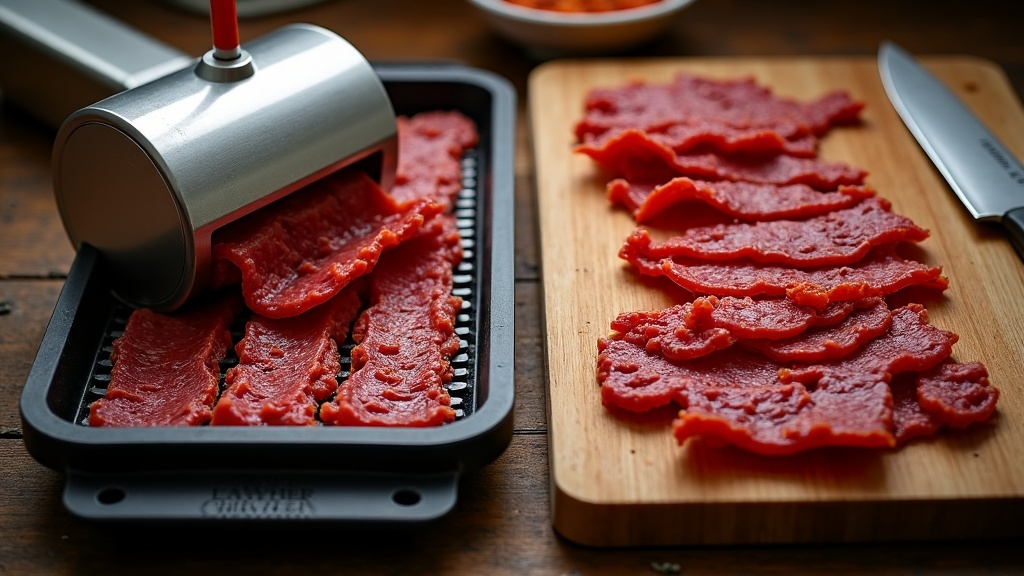
A jerky gun (sometimes called a jerky shooter or jerky cannon) looks like a large caulking gun. You load seasoned ground meat into the barrel, then squeeze the trigger to extrude uniform strips or sticks onto your dehydrator trays. Most guns come with interchangeable nozzles — flat strip, round stick, and sometimes a wide flat nozzle for thinner pieces.
The concept is simple: take ground meat (typically 90/10 or 93/7 lean-to-fat ground beef), mix in your cure and seasonings, load the gun, and press out consistent strips. The entire process from mixing to loading trays can take under 30 minutes for a 5-pound batch.
Popular jerky guns include the LEM Products Jerky Gun, which handles both strips and sticks, and the Weston Jerky Gun — both workhorses I’ve used extensively. For beginners on a budget, the Nesco Jerky Works Kit comes with seasoning packets and gets the job done for about $25.
According to the USDA’s Food Safety and Inspection Service, ground meat jerky should reach an internal temperature of 160°F (165°F for poultry) to ensure pathogen destruction — a critical safety point since grinding meat can introduce bacteria throughout the product (USDA FSIS Jerky Guidelines).
The Art of Slicing: Whole-Muscle Jerky
Traditional sliced jerky starts with a whole cut of meat — top round, bottom round, eye of round, flank steak, or London broil are the classics. You trim the fat, partially freeze the meat (about 1-2 hours until firm but not solid), and then slice it into strips roughly ⅛ to ¼ inch thick.
Slicing direction matters enormously. Cut with the grain for chewy, traditional-style jerky that tears into strips. Cut against the grain for a more tender, brittle bite that breaks apart easily. Most commercial jerky is cut with the grain, and that’s what I recommend for beginners.
A sharp knife works fine, but a Chef’sChoice Electric Meat Slicer dramatically speeds up the process and gives you consistent thickness — which is the single biggest factor in even drying. If you’re making jerky regularly, it’s a game-changer.
After slicing, strips go into a marinade for 12-24 hours. This is where whole-muscle jerky really shines: the marinade penetration into intact muscle fibers creates layered, complex flavor that’s hard to replicate with ground meat. A study published in the Journal of Food Science (Vol. 73, Nr. 4, 2008) found that marinated whole-muscle jerky retained more of its original meat flavor compounds compared to restructured (ground) jerky products.
Head-to-Head: Texture, Flavor, and Yield
Texture
This is the biggest difference. Jerky gun jerky has a uniform, slightly crumbly texture similar to a Slim Jim or commercial meat stick. It’s softer, easier to chew, and has a consistent bite from edge to edge. Some people love this; others find it lacks the satisfying tear of real jerky.
Sliced jerky has that classic fibrous pull. Each piece has a grain you can see and feel. It’s chewier and more varied — thinner spots get crispier, thicker spots stay more pliable. This is what most people picture when they think “jerky.”
Flavor
Jerky gun jerky absorbs seasonings uniformly since they’re mixed directly into the ground meat. Every bite tastes the same. That’s an advantage for consistency, but it can feel one-dimensional.
Sliced jerky develops a flavor gradient — the outside carries more marinade intensity while the center retains more pure meat flavor. This creates a more interesting eating experience, in my opinion. The 12-24 hour marinade time also develops deeper flavors through enzymatic processes.
Yield and Cost
According to my kitchen logs from the last two years: ground beef jerky typically yields about 40-45% of the raw weight as finished jerky. Whole-muscle cuts yield about 35-40% after trimming fat and accounting for moisture loss.
However, ground meat (90/10 lean) typically runs $5-7/lb at most grocery stores, while top round or eye of round averages $6-9/lb. When you factor in trimming waste from whole muscle (about 10-15% lost to fat and silverskin), jerky gun jerky is about 20-30% cheaper per ounce of finished product. For large batches, that adds up fast.
Ease of Use: Which Method Is More Beginner-Friendly?
I’ll be blunt: the jerky gun is significantly easier for beginners. Here’s why:
- No slicing skill required. Getting uniform ⅛-inch slices with a knife takes practice. Uneven slices mean uneven drying, which means some pieces are overdone while others are still moist. A jerky gun produces perfectly uniform strips every time.
- No marinating wait. Seasonings get mixed directly into the ground meat, so you skip the 12-24 hour marination period. You can go from raw meat to dehydrator in under 30 minutes.
- Simpler meat prep. No partial freezing, no trimming silverskin, no worrying about grain direction. Just buy ground beef and go.
- Consistent results. With a jerky gun, your 10th batch will look almost identical to your first. Slicing takes many batches to master.
That said, slicing isn’t rocket science. If you have decent knife skills and follow a good guide, you can produce great sliced jerky on your first try. It just requires more attention to detail. I recommend starting with a partially frozen eye of round — it’s lean, affordable, and the cylindrical shape makes consistent slicing easier.
For dehydrating either type, you’ll want a reliable dehydrator. I use and recommend the Nesco FD-75A Snackmaster Pro for beginners — it handles 5-pound batches easily and costs under $70. If you’re serious about the hobby, the COSORI Premium Stainless Steel Dehydrator gives you precise temperature control and larger capacity.
When to Use Each Method: My Practical Guide
After years of making both styles, here’s my honest take on when to use each approach:
Use a jerky gun when:
- You’re brand new to jerky making and want quick wins
- You’re making large batches for events, camping trips, or gifts
- You want to experiment with wild game that’s already been ground (venison gun jerky is phenomenal)
- Budget is a priority — ground meat is cheaper and wastes less
- You prefer a softer, more uniform texture
- You need speed — no marinating time needed
Slice your jerky when:
- You want that classic chewy, fibrous jerky texture
- Flavor complexity is your priority
- You enjoy the craft and meditative process of slicing and marinating
- You’re working with premium cuts and want to showcase the meat itself
- You want jerky that closely matches commercial whole-muscle brands
- You have a meat slicer and can produce consistent thickness efficiently
Here’s my actual ratio at home: about 60% of my batches are sliced whole-muscle, 40% are jerky gun. When I’m making jerky as a weeknight project after work, the gun comes out. When I’ve got a weekend to enjoy the process, I’m reaching for the cutting board and my eye of round.
Pro Tips for Both Methods
Whichever method you choose, these tips will improve your results:
For jerky gun users:
- Use the leanest ground meat you can find — 93/7 or 96/4. Fat doesn’t dehydrate well and causes rancidity. Some specialty shops carry 96/4 ground beef specifically for jerky.
- Mix your seasoned meat in a stand mixer with the paddle attachment for 2-3 minutes until it becomes tacky and slightly sticky. This improves binding and gives you strips that hold together better.
- Refrigerate the loaded gun for 15-20 minutes before extruding. Cold meat extrudes more cleanly and holds its shape on the tray.
- Always use Instacure #1 (Prague Powder) or a pre-mixed cure when making ground meat jerky. The USDA recommends this as an additional safety step since ground meat has higher bacterial risk.
For slicers:
- Freeze the meat for exactly 1.5-2 hours. You want it firm enough to slice cleanly but not frozen solid. Press the meat with your thumb — you should leave an indent, but it should feel very firm.
- Use a long, sharp knife (at least 10 inches) and make smooth, single-pass cuts. Sawing back and forth creates ragged edges that dry unevenly.
- Pat your sliced strips dry with paper towels after marinating. Excess surface moisture extends drying time and can cause case hardening — where the outside dries before the inside, trapping moisture.
- Keep strips between ⅛” and ¼” thick. Thinner than ⅛” and they’ll be brittle chips. Thicker than ¼” and you’ll be drying for 12+ hours.
For everyone:
- Dehydrate at 160°F (or your dehydrator’s highest jerky setting). The USDA and state extension programs recommend this temperature for safe jerky production.
- Jerky is done when it bends and cracks but doesn’t break in half. It should feel dry to the touch with no sticky or moist spots.
- Store finished jerky in vacuum-sealed bags for maximum shelf life. Properly dried and sealed jerky can last 1-2 months at room temperature or 6+ months in the freezer.
Frequently Asked Questions
Is jerky gun jerky safe to eat?
Yes, as long as you follow USDA guidelines. Use curing salt (Instacure #1), dehydrate at 160°F, and ensure the internal temperature reaches 160°F for beef or 165°F for poultry. Ground meat does carry slightly higher food safety risk than whole muscle, so proper curing and temperature control are essential.
Can you use a jerky gun with venison or turkey?
Absolutely. Ground venison makes outstanding gun jerky — many hunters consider it the best use for trim and less desirable cuts. Ground turkey works too, but use 93/7 lean and be extra careful about food safety since poultry requires 165°F internal temperature.
How long does each method take from start to finish?
Jerky gun method: about 30 minutes of prep plus 4-6 hours of drying. Sliced method: 15-20 minutes of prep, 12-24 hours of marinating, then 5-8 hours of drying. The gun method is dramatically faster for same-day jerky.
Which method produces better-tasting jerky?
This is subjective, but in my experience sliced whole-muscle jerky has more complex flavor and a more satisfying texture. However, well-seasoned jerky gun jerky can be just as addictive — it’s a different product. I recommend trying both and deciding for yourself.
Do I need a dehydrator for either method?
A dehydrator gives the best and most consistent results, but you can use your oven set to its lowest temperature (170-200°F) with the door propped open slightly. This works for both methods. A dehydrator is more energy-efficient and gives you better airflow control, which is why I strongly recommend investing in one.