Affiliate Disclosure: Some links in this article are affiliate links. If you purchase through them, I may earn a small commission at no extra cost to you. I only recommend products I actually use and trust.
I’ve ruined more batches of jerky than I’d like to admit — either pulling it too early and dealing with chewy, borderline-unsafe strips, or leaving it too long and ending up with something closer to charcoal than food. After years of making jerky at home and digging into the food science behind it, I’ve landed on a reliable system that combines old-school tactile tests with USDA-backed temperature guidelines. Here’s everything you need to know about how to tell if homemade jerky is done.
The Four Doneness Signals You Should Check Together
No single test tells the whole story. The most reliable approach is checking four signals simultaneously: internal temperature, smell, appearance, and texture. Think of them as four votes — you want a majority saying “done.”
1. Internal Temperature
The USDA and the National Center for Home Food Preservation are clear on this one: beef jerky must reach an internal temperature of 160°F (71°C) to eliminate pathogens like Salmonella and E. coli. For poultry-based jerky, that target rises to 165°F. The tricky part is that jerky strips are thin — usually 3/16 to 1/4 inch — which makes accurate probe readings hard to get. I’ll cover the workaround in the temperature section below.
2. Smell
Done jerky smells savory, slightly smoky (even if you didn’t smoke it), and deeply concentrated — like a cooked beef reduction. Underdone jerky still has that raw-meat tang underneath the marinade, especially when you tear it. Trust your nose. If something smells off or still “wet,” it’s not ready.
3. Appearance
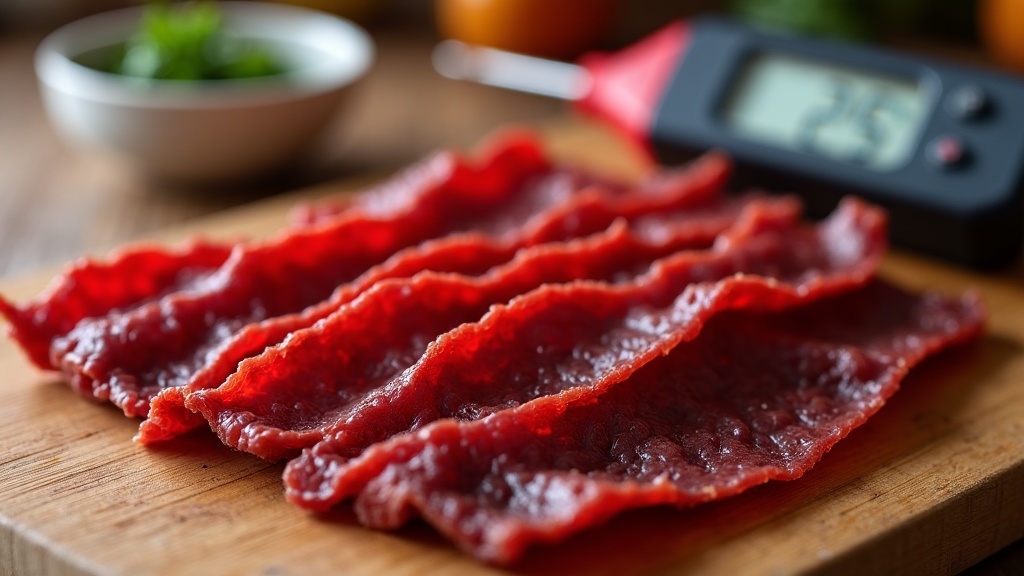
Finished jerky should be uniformly dark — mahogany to dark brown — with no pink or grayish sections on the interior when you tear a piece. The surface should be dry and slightly glossy from concentrated sugars and proteins, not wet or tacky. Thicker sections that still look pale in the middle need more time.
4. Texture
This is the one most experienced jerky makers rely on most: the bend test. And we’re going to dedicate a full section to it because it’s that important.
The Bend Test Explained: The Single Most Useful Doneness Check
Ask any serious home jerky maker how they know it’s done and they’ll tell you the same thing. The Rokslide hunting and outdoor forums — where people have been drying meat for backcountry trips for decades — sum it up perfectly: “Bend it and if it cracks or starts to tear and is white, it’s done.”
Here’s how to do the bend test correctly:
- Let the strip cool completely first. This is the step most beginners skip. Hot jerky is always more pliable than cooled jerky because residual heat keeps moisture mobile in the muscle fibers. Pull a strip off the rack and let it sit on a clean surface for 5 minutes. Don’t test it hot.
- Hold it with both hands, about an inch apart from the center.
- Bend it in half in a smooth motion.
- Watch and feel what happens at the bend point.
What you’re looking for:
- Done: The outer surface of the bend cracks — you may see white fibrous connective tissue exposed at the crack. The strip bends but doesn’t fully break. NDSU Extension puts it this way: “When cool, it should crack but not break when bent.”
- Underdone: The strip bends smoothly with no cracking, like a piece of cooked chicken breast. Feels rubbery. Needs more time.
- Overdone: The strip snaps cleanly in two with very little resistance. Dry and brittle. Still safe to eat, but the texture is unpleasant and the flavor has started to degrade.
Test multiple strips from different parts of the dehydrator or oven, especially from the middle trays or center of the rack where airflow is usually weakest. I’ve had batches where the outer strips were perfect and the inner ones needed another hour.
For a reliable dehydrator that gives consistent airflow across all trays — which makes the bend test more uniform across your batch — I’ve had great results with the Excalibur 9-Tray Dehydrator. The horizontal airflow design eliminates the hot-spot problem that makes vertical-stack dehydrators so inconsistent.
Temperature and Time Guidelines: What the Research Actually Says
The food safety literature on jerky is more nuanced than most home recipes let on. A PubMed study (PMID 30934529) on domestic preparation of jerky found that home-prepared jerky presents “little risk provided initial drying temperatures are adequate” — the key word being “initial.” Starting at a high enough temperature matters more than the average temperature over the drying period.
Here are the guidelines I follow, based on USDA and NDSU Extension recommendations:
| Method | Temperature | Notes |
|---|---|---|
| Dehydrator | 145–165°F | NDSU recommends 140–150°F minimum; higher is safer |
| Oven | 170–200°F with door cracked | Lowest reliable setting on most home ovens |
| Smoker | 225°F or higher initially | Smoke flavor + safe starting temp |
A research study published in the Journal of Food Science (PMID 22064293) evaluated physical and chemical characteristics of beef jerky at 3, 4, 5, 6, and 7 hours of drying. The study found measurable differences in moisture content, water activity, and texture at each interval — confirming that time is not a reliable standalone indicator. A thin strip at hour 4 might be done. A thick strip at hour 7 might not be.
My timing rule of thumb:
- Sliced 3/16″ thick, dehydrator at 160°F: Done in 4–5 hours
- Sliced 1/4″ thick, dehydrator at 145°F: Done in 5–7 hours
- High-sugar marinades (teriyaki, honey-based): Add 30–60 minutes, as sugar slows drying
Ohio State University Extension recommends beginning to check jerky after about 3 hours to avoid over-drying — not because it’s likely to be done that early, but because you want to catch any thin edge pieces before they turn to cardboard.
To actually measure internal temperature in a thin strip, I use the ThermoWorks Thermapen ONE inserted sideways along the length of the strip (not perpendicular through the thickness). This gives you a reading from inside the meat rather than the surface. Commercial operations use needle-thin probes and water activity meters that aren’t practical for home kitchens, but the Thermapen gets close enough for confident readings.
What Underdone vs. Overdone Jerky Looks Like
Knowing what you’re trying to avoid is just as useful as knowing what you’re aiming for.
Signs of Underdone Jerky:
- Soft, squishy, or springy when squeezed — especially in thicker center sections
- Pinkish or grayish interior when torn (not uniformly dark brown)
- Wet or tacky surface — picks up fingerprints easily
- Bends without any cracking on the bend test
- Smells “raw” or overly marinade-forward with no developed savory depth
- Looks shiny-wet rather than dry-glossy
Underdone jerky is a real food safety risk. A PubMed study on home-style beef jerky preparation methods (PMID 11510659) specifically examined how four common home preparation methods affected consumer safety — and found that low initial drying temperatures were the primary failure point. If you suspect your jerky is underdone, it goes back in. No exceptions.
Signs of Overdone Jerky:
- Snaps cleanly in two on the bend test with almost no resistance
- Very dark, almost black in color — especially on thinner sections
- Brittle, cardboard-like texture with no chew
- Flavor is flat or slightly bitter — the Maillard reaction has gone too far
- Crumbles when you tear it rather than pulling apart in fibers
Overdone jerky is safe to eat but not enjoyable. If you catch it early (just snapping but still flavorful), it works well crumbled into soups, stews, or trail mix. If it’s truly desiccated all the way through, it’s basically jerky powder — still not dangerous, just disappointing.
The Goldilocks Zone: What you want is jerky that cracks but doesn’t break, pulls apart in fibrous strands, has a chewy-but-not-rubbery bite, and looks uniformly dark brown throughout with a slightly firm, dry surface.
The Post-Drying Safety Step Most People Skip
Here’s the part that surprises most home jerky makers when they first hear it: the USDA and National Center for Home Food Preservation recommend a post-drying oven step as a safety backup, particularly when using a dehydrator.
The reasoning is solid. Dehydrators — especially lower-end models without precise temperature control — may not reliably hit 160°F throughout a full batch. Temperature varies by tray position, how loaded the unit is, and ambient kitchen temperature. The solution is simple: once you’ve confirmed doneness by bend test and appearance, spread your jerky strips in a single layer on a baking sheet and place them in a 275°F oven for 10 minutes.
This step:
- Provides a confirmed heat kill step for any pathogens that may have survived the drying phase
- Doesn’t significantly change texture — the jerky is already dry enough that 10 minutes at 275°F just adds a brief heat exposure
- Gives you documented peace of mind, especially if you’re making jerky for other people, kids, or immunocompromised individuals
I know — it feels redundant when you’ve already been drying meat for 6 hours. But I’ve made this a non-negotiable part of my process since I read through the USDA’s jerky safety guidelines seriously. The 10 minutes is worth it.
One more thing worth mentioning: proper storage after the post-drying step matters. Let the jerky cool completely before sealing — sealing warm jerky traps steam and creates moisture, which is exactly what you spent 6 hours removing. I store mine in mason jars or vacuum-sealed bags. At room temperature it’s good for 1–2 weeks; refrigerated, up to a month; frozen, up to a year.
If you’re ready to upgrade your setup for more consistent results, I’ve found the COSORI Premium Dehydrator to be a solid mid-range option with accurate temperature control and good airflow. Consistent heat means the bend test gives you consistent results batch after batch.
Frequently Asked Questions About Jerky Doneness
What temperature should homemade jerky reach to be safe?
According to the USDA, beef jerky must reach an internal temperature of 160°F (71°C) to be food-safe. Because thin strips are hard to probe accurately, the USDA recommends a post-drying oven step at 275°F for 10 minutes as a safety backup after the drying phase is complete.
How do I do the bend test for jerky?
Let the strip cool to room temperature first — this is critical. Then hold a strip with both hands and bend it in half. Done jerky will crack along the outside of the bend (you may see white fibrous tissue) but shouldn’t snap completely in two. No cracking means it needs more time; clean snap means it’s overdone.
How long does it take for homemade jerky to be done in a dehydrator?
Most beef jerky takes 4–7 hours in a dehydrator set to 145–165°F, depending on slice thickness and marinade. Research evaluating jerky at 3 through 7 hours of drying found significant differences at each interval. Start checking at 3 hours, but expect most batches to finish in 5–6 hours.
What does underdone jerky look like?
Underdone jerky is soft and squishy, especially in thicker sections. It bends without cracking, may feel wet or tacky on the surface, and the interior will look pinkish rather than uniformly dark brown. Underdone jerky is a food safety risk and must be returned to the dehydrator or oven.
Can I use a meat thermometer to test jerky?
Yes, with technique. Insert a thin-tipped thermometer sideways along the length of the strip rather than poking straight through the thickness. Aim for 160°F for beef. Always combine thermometer readings with the bend test for best accuracy. Commercial operations use needle-thin probes and water activity meters; the closest home-kitchen equivalent is a high-quality instant-read thermometer like the ThermoWorks Thermapen.