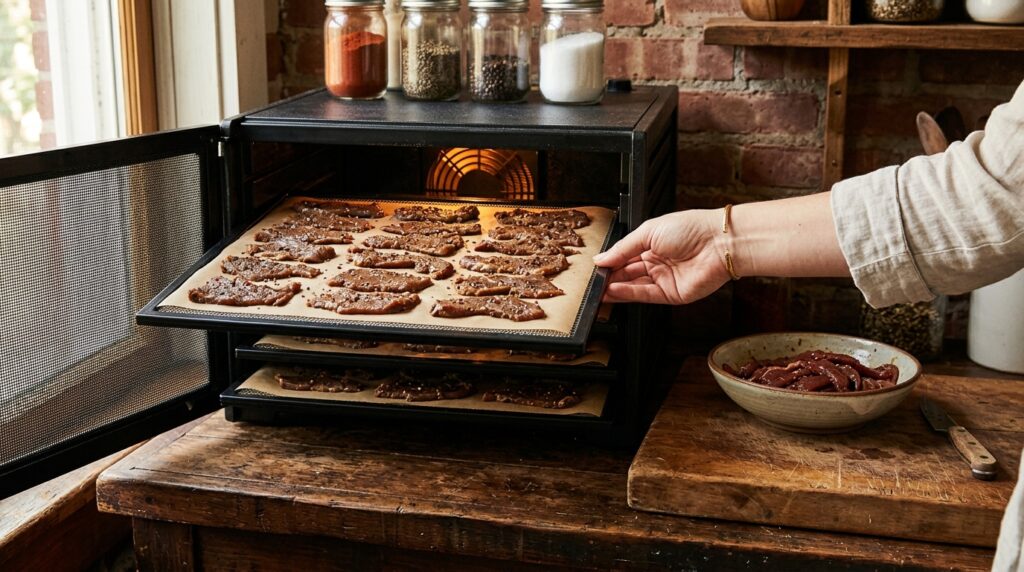
I can usually tell in the first two hours when a batch is heading for trouble. A few strips on the front edge start getting stiff, the thicker ones in back still look wet, and now you are playing dehydrator roulette. If your jerky is not drying evenly, the fix usually is not magic time or a hotter dial. It is almost always a mix of uneven slice thickness, too much surface moisture, crowded trays, or airflow that is getting blocked.
After 400-plus batches in my garage, my practical rule is simple: make the meat uniform, load the trays like airflow matters, and pull finished pieces as they are done instead of forcing the whole batch to march at one speed. These jerky not drying evenly dehydrator tips are the stuff that actually moved my batches from random to repeatable, and they will save you from over-drying half a pound just to rescue the rest.
The Short Answer
If your jerky is drying unevenly in a dehydrator, start by assuming the pieces are not as equal as they looked on the cutting board. A strip that is 1/4 inch thick beside one that is 1/8 inch thick can finish hours apart. Add a sugary marinade, strips touching on the tray, or a dehydrator with weaker airflow on one side, and you get dry tips, damp centers, and a batch that feels all over the map.
The fastest reliable fix is to slice more consistently, blot off excess marinade, leave space between pieces, rotate trays if your machine dries unevenly, and remove finished strips as you go. For safety, keep USDA guidance in mind: meat should reach 160 degrees Fahrenheit before or during a safe jerky process, because dehydrating alone may not kill pathogens first. USDA and the National Center for Home Food Preservation both spell that out, and NCHFP also notes jerky should dry until it cracks but does not break when bent. See USDA FSIS jerky guidance and NCHFP jerky instructions.
What Is Causing the Problem
Uneven drying is usually a stack-up of small mistakes, not one dramatic failure. Home dehydrators work by moving warm air across the food. NCHFP describes dehydrators as using heat, a fan, and vents for air circulation, which is why tray layout matters more than people think. When one part of that system gets compromised, some strips dry faster while others lag behind. See NCHFP on food dehydrators.
- Uneven slice thickness: This is the big one. Thin tail pieces finish first, thick center cuts stay rubbery, and you end up over-drying the easy pieces while waiting on the rest.
- Too much marinade left on the meat: Wet surfaces slow down drying, especially with honey, brown sugar, or teriyaki-style batches. I learned this the expensive way on a two-pound batch that looked great going in and came out patchy because I skipped the blotting step.
- Trays loaded too tight: NCHFP recommends placing pieces close together but not touching or overlapping. If strips touch, you block airflow and create damp spots.
- Dehydrator airflow pattern: Some round stackers dry harder near the fan or heating path than at the opposite side. That is not always a broken machine. It can just be the way that model moves air.
The last cause is what jerky makers call case hardening: the outside dries too fast and firms up while moisture is still trapped deeper in the strip. That can happen when the surface is thin, the interior is thick, or you try to brute-force the batch with higher heat. The result is jerky that feels done on the edges but still bends wet or squeezes soft in the middle.
How I Fix It Batch to Batch
I do not try to fix uneven jerky after the dehydrator is already full. I build the batch so it has a chance to dry evenly from the start. That sounds obvious, but this is where most waste happens. A cheap pound of eye of round turns expensive fast when you lose texture on half the tray.
- Slice for consistency, not speed: I aim for about 1/8 to 3/16 inch and I stick to it. If your knife work varies, a meat slicer for jerky is one of the few tools that genuinely pays for itself if you make jerky often.
- Blot every strip before loading: I let the marinade drain, then press both sides with paper towels. You want flavor on the meat, not puddles on the tray.
- Leave real space between pieces: Not huge gaps, just enough that edges are exposed and air can travel. If I have too much meat for one run, I do two smaller batches instead of one overloaded batch.
- Sort by thickness and pull in waves: Thin pieces go on one tray, thick pieces on another when possible. Then I start checking early and remove finished strips one tray at a time. This one habit fixed more over-drying than anything else I changed.
I also stop trusting the factory timer like it knows my meat, my marinade, my humidity, and my garage. It does not. Oklahoma State notes jerky drying time varies with thickness, temperature, humidity control, and equipment setup, which matches real life perfectly. Use the timer as a reminder to check, not as the boss. See this Oklahoma State Extension jerky drying reference.
What to Check First
If a batch is already drying unevenly, do not immediately crank the temperature and hope. Check the likely failure points in order. That gives you a decent shot at saving the batch without turning the front row into boot leather.
| Symptom | Most Likely Cause | What I Do |
|---|---|---|
| Edges dry fast, middle stays soft | Pieces too thick or inconsistent | Move thicker pieces together, keep drying those, remove the thin ones now |
| Wet patches where strips touch | Crowded trays | Separate pieces immediately and spread the batch across more space |
| Front trays finish early, back trays lag | Airflow pattern in the dehydrator | Rotate trays and, if needed, rotate tray position every 1 to 2 hours |
| Outside feels dry but strip bends mushy | Case hardening or too much surface sugar | Lower the urge to increase heat; keep drying with airflow and monitor closely |
- Check spacing first: This is the easiest fix mid-batch. If strips shifted and started touching, separate them now.
- Check thickness second: Pick up the lagging pieces and compare them side by side with the finished ones. If they are clearly thicker, stop treating the whole batch like one unit.
- Check your actual temperature: A lot of home units are not exact. An instant-read thermometer for jerky helps on the food-safety side, and a separate oven or appliance thermometer can tell you whether your dehydrator runs hot or cold.
- Check for sugary buildup or heavy marinade: Sweet glazes can stay tacky longer and make you think the whole strip is underdone when it is really the surface finish fooling you.
If your dehydrator is a stackable round model, I would assume tray rotation is part of the process unless you have proven otherwise. On my older unit, top and bottom trays never matched without swapping positions. Horizontal-flow units are usually more even, but even those can struggle when one tray is overloaded and another is not.
When to Toss It and Start Over
Texture problems are annoying. Safety problems are different. If the jerky sat too long in the danger zone before drying, smells sour instead of savory, feels greasy and damp after cooling, or gets beads of moisture in storage, I do not negotiate with it. I toss it. USDA warns that dehydrating meat without getting it to a safe temperature first is risky because bacteria can survive and become more heat resistant after drying. That is why their jerky guidance says to heat meat to 160 degrees Fahrenheit before dehydrating, and 165 degrees Fahrenheit for poultry. See USDA FSIS.
I also start over when the batch is technically safe but clearly not worth the chewing. If half the tray is shattered dry and the rest is still awkwardly soft, you can sometimes chop it for dog treats or soup seasoning, but you are not rescuing that into great jerky. Real talk: sometimes the cheapest move is to stop spending time and electricity on a bad batch, note what went wrong, and make the next run better.
Bottom Line
The real fix for uneven jerky is process control, not wishful thinking. Cut the meat evenly, keep the strips from touching, blot off extra marinade, and let airflow do its job. Then check early, rotate trays when your machine needs it, and pull finished pieces in stages. That is how you stop sacrificing the whole batch to the slowest strip.
If you want one practical takeaway from my garage jerky lab, it is this: consistency saves money. A cleaner load and more uniform slices beat fancy marinades every time when the goal is texture. Build the batch right, follow the food-safety guidance from USDA and NCHFP, and your next run should come out a whole lot more even and a whole lot less frustrating.