Tips for Using a Food Dehydrator: Common Mistakes Fixed
I’ve wasted more beef than I care to admit learning how to use a food dehydrator properly. Eight years and 400+ batches later, I can spot the mistakes that’ll ruin your jerky from a mile away — because I’ve made almost every single one.
The biggest mistakes people make with food dehydrators are overcrowding trays, setting the wrong temperature, and not preheating the unit. These three issues alone account for about 80% of the “why is my jerky terrible?” questions I get. Let me walk you through what actually works.
The Seven Mistakes That Ruin Most Batches
1. Overcrowding Your Trays
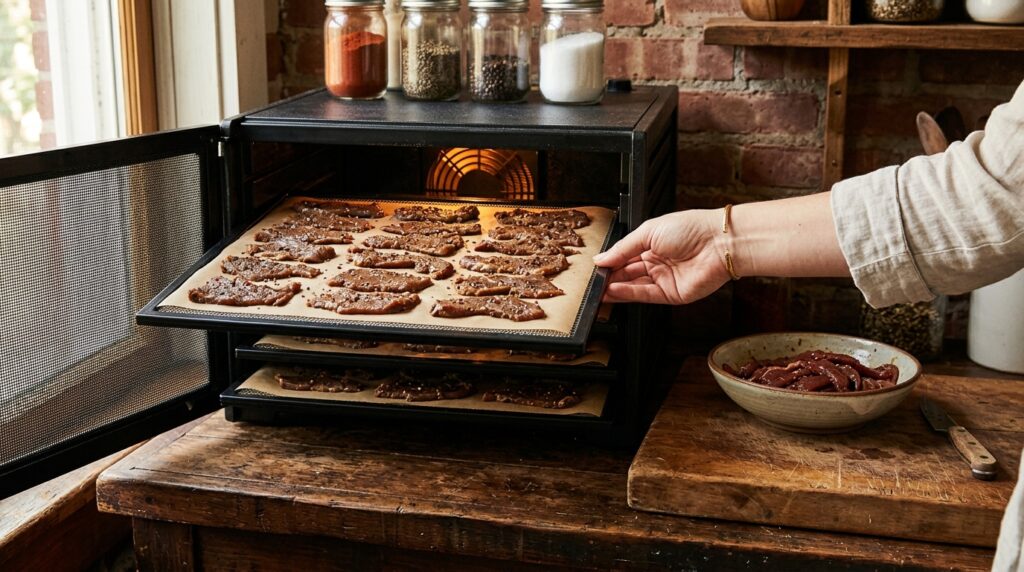
This is the number one problem I see. You’ve got 5 pounds of marinated meat and you’re trying to cram it all onto every available inch of tray space. The strips are touching, overlapping, basically spooning each other.
Here’s what happens: the air can’t circulate properly. You get partially dried jerky on the edges and still-wet meat in the middle. Some pieces finish in 4 hours while others need 8. It’s a mess.
The fix is simple but requires patience. Leave at least a quarter-inch between each piece. If you run out of tray space, do two batches. I learned this after ruining a $40 batch of venison by trying to rush everything through at once.
2. Not Preheating the Dehydrator
Most people just load up their trays and turn the machine on. But if you’re making jerky (especially with raw meat), you want to hit a safe temperature quickly. The USDA recommends getting meat to 160°F within the first few hours.
I preheat mine for 10-15 minutes before loading the trays. It’s the same principle as preheating your oven. Starting with a hot environment means more consistent results and better food safety.
3. Wrong Temperature Settings
I spent my first year making jerky at 145°F because that’s what some random website said. Half my batches came out too dry, almost brittle. The other half took forever to dry properly.
For beef jerky, I run 160-165°F. For fruit and vegetables, 125-135°F works better. Here’s what I’ve learned works for different foods:
| Food Type | Temperature | Typical Time | Sam’s Notes |
|---|---|---|---|
| Beef/Venison Jerky | 160-165°F | 4-6 hours | Rotate trays every 2 hours |
| Chicken/Turkey Jerky | 165°F | 5-7 hours | Must hit 165°F quickly |
| Fruit (apples, bananas) | 135°F | 6-12 hours | Lower temp preserves flavor |
| Vegetables | 125-135°F | 6-10 hours | Blanch first for best results |
| Herbs | 95-115°F | 2-4 hours | Low and slow keeps oils |
4. Never Rotating Your Trays
Most dehydrators have a heating element at the bottom or back. That means the trays closest to the heat source dry faster. If you don’t rotate them, you get uneven results.
I rotate my trays every 2 hours. Bottom tray goes to the top, top goes to the middle, everything shifts. It adds maybe 2 minutes to your day but makes a huge difference in consistency. With a good stackable food dehydrator, this is easy — just swap the trays around.
5. Inconsistent Slicing Thickness
You’ve got some pieces cut at ¼ inch, others at ⅛ inch, maybe a few chunky ones at ½ inch. They’re not going to dry at the same rate. The thin ones turn into beef chips while the thick ones are still chewy.
I freeze my meat for 1-2 hours before slicing. It firms up enough to get consistent cuts. Aim for ¼ inch thick — any thinner and you risk over-drying, any thicker and you’re adding hours to your drying time.
If you’re serious about consistency, a meat slicer is worth the investment. I resisted for three years thinking it was overkill. Now I can’t imagine going back to knife work.
6. Skipping the Blot Step
After marinating, most people just pull the meat out and throw it straight on the trays. All that excess marinade drips down, pools on the trays, and extends your drying time by hours.
Pat your meat dry with paper towels before loading. It takes 30 seconds per batch and cuts drying time by 25-30%. Less liquid means faster drying and better texture.
7. Not Checking for Hot Spots
Every dehydrator has them — areas that run hotter than others. I learned this when I kept getting one corner of jerky that was always overdone. Turns out my dehydrator runs about 10°F hotter in the back right quadrant.
Test yours by running a batch of plain beef strips with no marinade. Check which pieces dry fastest. Now you know where your hot spots are. Put your thicker cuts there, thinner cuts in the cooler zones.
Equipment Upgrades That Actually Matter
I’m not big on gadgets for the sake of gadgets, but a few things have genuinely improved my results.
Get a Separate Temperature Probe
The built-in thermometer on your dehydrator might be lying to you. Mine was reading 165°F but actually running at 152°F. I bought a basic digital probe thermometer for $15 and discovered the truth.
Stick the probe in the middle of your dehydrator stack and check the actual temperature. Adjust your settings accordingly. This alone fixed about half the consistency issues I was having.
Non-Stick Sheets for Marinades
If you’re doing heavy marinades or making anything with ground meat, mesh sheets save you from scraping dried marinade off your trays for 20 minutes. They’re reusable, dishwasher safe, and cost about $10 for a set.
Maintenance Mistakes That Shorten Your Dehydrator’s Life
Not Cleaning Between Batches
Old marinade residue builds up. It burns, smokes, and makes everything taste vaguely like your last batch. I wash my trays with hot soapy water after every use. Takes 5 minutes, keeps everything tasting clean.
Storing It While Still Warm
Let your dehydrator cool completely before putting it away. Trapping heat and moisture creates a perfect environment for mold. I learned this when I opened mine after a month and found spots growing in the corners.
How to Tell When It’s Actually Done
This trips up everyone starting out. You pull a piece out, it bends without breaking, seems dry enough. Then you store it and three days later it’s moldy.
Proper jerky should bend but crack slightly when you fold it. It shouldn’t be brittle (that’s overdone) but it shouldn’t be pliable like raw meat either. The middle ground is what you’re after.
I do the bend test on multiple pieces from different trays. If they all pass, I pull the batch. If some are still too flexible, those go back for another hour.
Storage Tips After Dehydrating
Even if you dry everything perfectly, bad storage will ruin it. I let my jerky sit out on paper towels for 30-60 minutes after dehydrating. This “conditioning” period lets any remaining moisture distribute evenly.
Then it goes into airtight containers or vacuum-sealed bags. Store in a cool, dark place. Properly dried and stored jerky lasts 1-2 months at room temperature, 6 months in the fridge, a year in the freezer.
Frequently Asked Questions
How full can I load my dehydrator trays?
Leave at least ¼ inch between pieces. Fill the trays maybe 70-80% full, not 100%. Air circulation is more important than maximizing space. Overcrowding extends drying time and creates uneven results.
Why does my jerky turn out too dry and brittle?
Either your temperature is too high or you’re drying too long. For beef jerky, 160-165°F for 4-6 hours usually works. Check at 4 hours and every 30 minutes after. Remember, it’ll firm up slightly more as it cools.
Can I dehydrate different foods at the same time?
Technically yes, but I don’t recommend it. Flavors and smells transfer. Your fruit will taste like beef jerky. Your jerky might taste like whatever else is in there. Stick to one type of food per batch.
Do I need to flip my jerky halfway through?
Not usually, if your dehydrator has decent airflow. I rotate the trays but I don’t flip individual pieces. If your dehydrator only heats from one side (like some cheaper models), flipping at the halfway point helps.
My dehydrator’s temperature isn’t accurate — should I replace it?
Not necessarily. Just compensate by setting it higher or lower based on what a separate thermometer tells you. My dehydrator runs 10°F cool, so I set it to 175°F to get actual 165°F. Works fine, saves money.