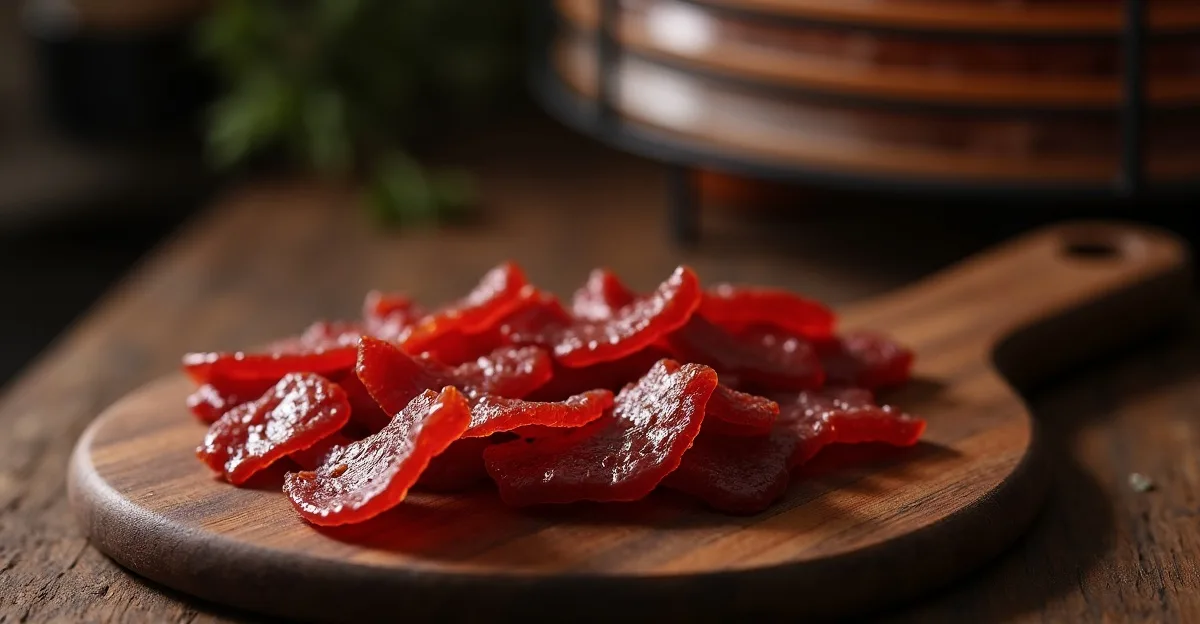
I’ve been making beef jerky for over a decade — first as a food science experiment, then as a full-blown obsession. I’ve dried meat in everything from $30 Walmart dehydrators to $800 commercial smokers, and I’ve tested enough marinade combinations to fill a notebook (which I have, actually).
Here’s the truth: good beef jerky isn’t complicated. But the difference between chewy, flavorful strips and dry cardboard comes down to a few key decisions — your cut of meat, your marinade, and your drying method. Get those right, and you’ll never buy store-bought jerky again.
In this guide, I’ll walk you through all four methods with real time/temp data, a base marinade recipe plus three variations, and the gear I actually use. Let’s get into it.
Best Cuts of Beef for Jerky
Before we talk methods, let’s talk meat. The cut you choose determines everything — texture, chew, flavor absorption, and how forgiving it is to dry.
Eye of Round (My #1 Pick)
Lean, tight grain, easy to slice uniformly. It dries predictably, has excellent chew, and is usually the cheapest per pound. If I’m making a big batch, this is what I buy.
Top Round
Slightly more marbling than eye of round, which some people prefer. Still very lean by beef standards. Great flavor. Slices well when partially frozen.
Flank Steak
Longer, more pronounced grain that makes it easier to slice “with the grain” for extra chewy jerky — or “against the grain” for a more tender bite. A bit more expensive but incredible flavor.
Pro tip: Partially freeze your meat (about 1-2 hours in the freezer) before slicing. It firms up enough to cut uniform 1/4-inch slices without a slicer. Speaking of which — if you’re making jerky regularly, a dedicated meat slicer will change your life.
Fat is your enemy. Trim every visible white bit. Fat doesn’t dehydrate — it turns rancid and will shorten your jerky’s shelf life dramatically.
The Base Marinade (+ 3 Variations)
Every marinade I use starts with this foundation. It’s balanced, deeply savory, and works with any drying method.
Base Marinade (for 2 lbs of meat)
- 1/2 cup soy sauce
- 2 tbsp Worcestershire sauce
- 1 tsp garlic powder
- 1 tsp onion powder
- 1 tsp black pepper
- 1/2 tsp curing salt (Prague Powder #1) — optional but extends shelf life
Mix, add meat, refrigerate 6–24 hours. Flip halfway through if possible.
Variation 1: Spicy Korean
Base marinade + 2 tbsp gochujang + 1 tbsp sesame oil + 1 tsp ginger powder + 1 tsp red pepper flakes
Variation 2: Sweet & Smoky BBQ
Base marinade + 3 tbsp brown sugar + 2 tbsp ketchup + 1 tsp smoked paprika + 1/2 tsp liquid smoke
Variation 3: Teriyaki
Base marinade (reduce soy to 1/4 cup) + 1/4 cup pineapple juice + 3 tbsp honey + 1 tbsp rice wine vinegar + 1/2 tsp ginger
Method 1: Dehydrator (Recommended)
A food dehydrator is the best tool for making beef jerky at home. The airflow is consistent, temperature is precise, and you can do big batches without babysitting it.
Step-by-Step
- After marinating, pat meat dry with paper towels. Wet meat steams instead of drying — you want the surface dry before it hits the trays.
- Lay strips on dehydrator trays in a single layer. No overlapping.
- Set temperature to 165°F. This hits the USDA safe internal temp for beef without pre-cooking.
- Dry for 4–6 hours, rotating trays every 2 hours.
- Check at the 4-hour mark. The jerky is done when it bends and cracks but doesn’t break completely.
Dehydrator Recommendations
- Cosori 6-Tray Dehydrator — Best mid-range option. Rear fan = even drying, digital controls, runs quiet.
- Excalibur 9-Tray — The gold standard for serious jerky makers. Expensive, worth it.
- Nesco Snackmaster — Budget-friendly, top-fan style, works fine for small batches.
Batch size advantage: With a 6-tray dehydrator, you can process 3–4 lbs of meat at once. That’s roughly 1.5–2 lbs of finished jerky — enough to last a week if you have any self-control (I don’t).
Method 2: Oven
No dehydrator? No problem. Your oven works great — it just takes a bit more attention.
Step-by-Step
- Preheat oven to its lowest setting — usually 170°F for most home ovens. Some ovens go down to 150°F.
- Line the bottom of the oven with foil to catch drips.
- Hang strips directly from the oven rack using toothpicks, or lay them on wire cooling racks set over sheet pans. Wire racks = airflow underneath = critical.
- Crack the oven door about 1–2 inches with a wooden spoon. This lets moisture escape. Without this step, your oven becomes a humid sauna and your jerky will take forever (or never fully dry).
- Dry at 3–4 hours, flipping once at the 2-hour mark.
Oven tip: If your oven has a convection setting, use it. The fan circulation dramatically speeds up drying and gives you more even results — closer to a real dehydrator.
Safety note: Because oven temp can be inconsistent, I recommend pre-heating your finished jerky to 275°F for 10 minutes if you’re not sure it hit 165°F internally. This kills any remaining pathogens.
Method 3: Air Fryer
This is the fastest method, and the results genuinely surprised me. If you’ve got an air fryer with a dehydrate function (or can set it to low temps), you’re in business.
Step-by-Step
- Pat meat strips dry after marinating.
- Set your air fryer to 160°F using the dehydrate setting, or the lowest available temperature.
- Lay strips in the basket in a single layer. Depending on your air fryer size, you may need to work in batches.
- Run for 2–3 hours, flipping strips at the 1-hour mark.
- Check texture. Air fryers vary significantly — some run hot and finish in 2 hours, others need closer to 3.
Limitation: Air fryers have smaller capacity than dehydrators. If you’re making large batches, this method gets tedious fast. But for a quick 1-lb batch? Hard to beat for speed.
Air fryer rec: The Cosori 5.8-qt air fryer has a dedicated dehydrate mode and holds a solid amount of strips.
Method 4: Smoker
The king of flavor. If you have a smoker (offset, pellet, or kettle grill with indirect setup), smoked jerky is in a completely different league.
Step-by-Step
- After marinating, pat strips dry and let them air-dry on a rack for 30 minutes at room temp. You want a slightly tacky surface (called the “pellicle”) so smoke adheres better.
- Set your smoker to 160–180°F. Low and slow. This is the critical range — too high and you cook the meat before it dries, too low and it takes forever.
- Choose your wood: hickory for bold and classic, applewood for sweet and mild, cherry for a fruity note that pairs great with teriyaki marinades.
- Lay strips directly on grates or hang them on jerky hooks. Leave space between strips for airflow.
- Smoke for 4–6 hours, checking at the 3-hour mark.
Pellet grill note: If you have a Traeger, Camp Chef, or similar pellet grill, most have a “Super Smoke” mode that works at low temps. Set it to 160–165°F with super smoke on and let it run. The results are extraordinary.
Smoker gear: Jerky hanging hooks let you maximize smoker space and give you 360° smoke contact on each strip.
How to Tell When Jerky Is Done
This is where most beginners screw up — either pulling it too early (still moist in the middle) or leaving it too long (brittle and dry as cardboard).
The bend test: Take a strip out, let it cool for 5 minutes (hot jerky always seems wetter than it is), then bend it. Perfect jerky should:
- Bend without breaking
- Show small cracks at the fold
- Have a slightly fibrous, leathery texture throughout
If it snaps cleanly: Over-dried. Still edible, just less pleasant.
If it just folds with no crack: Under-dried. Back in for another 30–60 minutes.
If the center looks dark/wet when you tear it: Definitely not done.
Storage
Properly dried jerky (without curing salt) lasts:
- Room temperature: 1–2 weeks in an airtight container
- Refrigerator: 1–2 months
- Freezer: 6+ months
If you used Prague Powder #1 in your marinade, room temp shelf life extends to 3–4 weeks.
Oxygen absorbers are a game-changer for long-term storage. Drop one in a mason jar of jerky and you can push shelf life significantly further. I use 300cc oxygen absorbers in wide-mouth quart jars.
For backpacking or gifting, vacuum seal bags are ideal. Vacuum seal individual servings and freeze — the jerky will be fresh when you pull it months later.
Essential Gear Summary
- Dehydrator: Cosori 6-Tray (best value) or Excalibur 9-Tray (best overall)
- Meat slicer: Electric meat slicer for consistent cuts
- Curing salt: Prague Powder #1
- Storage: Oxygen absorbers + mason jars or vacuum sealer
- Smoker jerky hooks: Stainless jerky hanging hooks
Final Thoughts
All four methods produce great jerky — they just suit different situations. The dehydrator is my everyday workhorse. The smoker is for when I want to impress people. The oven is what I used before I had a dehydrator and it worked fine. The air fryer is for when I need jerky fast and don’t want to wait.
Start with eye of round, try the base marinade, and use whatever drying method you have access to. Once you’ve dialed in your process, start experimenting with marinades and wood types. The rabbit hole goes deep — and it’s delicious the whole way down.
— Sam, JerkyScience.com

