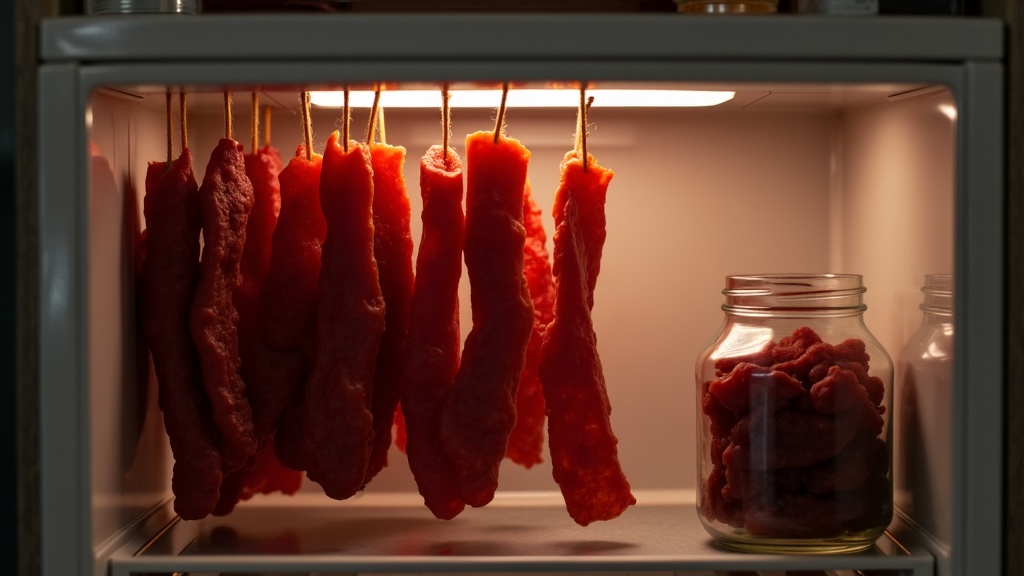
You’ve just ripped open a bag of beef jerky, eaten half of it, and now you’re staring at the rest wondering: do I need to refrigerate beef jerky after opening, or is it fine sitting on the counter? It’s a fair question — and the answer is more nuanced than the packaging lets on. As a food scientist who’s spent way too many hours obsessing over water activity curves and meat curing ratios, I’m here to give you the real story. Spoiler: it depends on whether you’re dealing with commercial jerky or homemade, and how long you plan to make it last.
Quick storage verdict
- Commercial jerky you will finish within a week: room temp is usually fine if you reseal it well.
- Commercial jerky you want to stretch longer: refrigerate it and stop overthinking it.
- Homemade jerky: refrigerate it after opening unless you know your water activity and process cold.
- Hot or humid house: default to the fridge even for commercial jerky.
If you make your own batches, pair this page with our guides to how long homemade jerky lasts, the best cuts for beef jerky, and the best dehydrators for jerky.
The Science Behind Jerky’s Shelf Stability
To understand why beef jerky doesn’t instantly rot at room temperature, you need to understand two key concepts: water activity (aw) and moisture content. These are the twin pillars of jerky preservation science.
Water activity measures how much “free” water is available in a food for microbial growth — on a scale from 0 (bone dry) to 1.0 (pure water). Most bacteria need a water activity above 0.91 to grow. Mold needs above 0.70. Properly made jerky typically sits between aw 0.60–0.85, which puts it firmly in the “microbially hostile” zone for bacteria.
Moisture content is the raw percentage of water by weight. The USDA recommends finished jerky have a moisture-to-protein ratio of no more than 0.75:1. In practical terms, this usually means moisture content below 25–30%. Most commercial jerky lands around 15–20% moisture.
Salt and curing agents (sodium nitrite) further suppress microbial activity by disrupting bacterial cell membranes and inhibiting enzymatic reactions. The combination of low water activity + salt + curing = a product that’s genuinely shelf-stable at room temperature.
But here’s the catch: “shelf-stable” doesn’t mean “immortal.” Once you open that bag, you’ve broken the hermetic seal, invited in oxygen and ambient humidity, and started the clock.
Commercial Jerky vs. Homemade: Not the Same Animal
This distinction matters enormously when deciding whether to refrigerate after opening.
Commercial Jerky
Brands like Jack Link’s, Oberto, and KRAVE produce jerky under strict USDA/FSIS-regulated conditions. Their products are:
- Made with precise moisture-to-protein ratios (verified by lab testing)
- Often contain sodium nitrite as a curing agent
- Vacuum-sealed or nitrogen-flushed to remove oxygen
- Packaged with oxygen absorbers in many cases
An unopened commercial jerky bag can last 1–2 years at room temperature. Once opened, you’re looking at 1–2 weeks at room temperature before quality noticeably degrades — though it may technically be safe a bit longer. Refrigeration extends this to 1–2 months, and freezing gets you up to 6 months or more.
Homemade Jerky
Here’s where I put on my food scientist hat and get serious with you: homemade jerky should almost always be refrigerated after opening (and often after making).
Why? Because home dehydrators don’t always achieve consistent temperatures across the entire batch. The USDA recommends meat reach an internal temperature of 160°F (71°C) to kill pathogens like Salmonella and E. coli O157:H7. Many home recipes skip a pre-heat step or rely solely on the dehydrator — which may only reach 130–140°F, not enough to guarantee pathogen kill.
Additionally, home jerky often lacks sodium nitrite (especially “clean label” recipes), meaning one of the primary antimicrobial barriers is missing. Without verified water activity measurements (most home cooks don’t own an aw meter), you’re flying blind on true shelf stability.
My recommendation for homemade jerky: refrigerate immediately, consume within 1–2 weeks, or freeze for up to 6 months.
How Long Does Jerky Last After Opening? A Practical Timeline
Here’s a breakdown you can actually use:
- Commercial jerky, room temperature (opened): 1–2 weeks (best quality), up to 3–4 weeks if stored in a cool, dry place
- Commercial jerky, refrigerated (opened): 1–2 months
- Commercial jerky, frozen: 6–12 months
- Homemade jerky, room temperature (opened): 3–5 days maximum (no nitrites), up to 1–2 weeks (with nitrites and confirmed low moisture)
- Homemade jerky, refrigerated: 1–2 weeks reliably
- Homemade jerky, frozen: 4–6 months
Temperature matters too. Storing jerky at below 70°F (21°C) significantly slows lipid oxidation (rancidity) and mold risk. The fridge, typically 35–40°F (1.7–4.4°C), is ideal for extending post-open shelf life. Avoid storing jerky anywhere temperatures fluctuate or exceed 80°F — think cars in summer, or near stovetops.
Room temperature vs fridge: the 30-second rule
| Situation | What I would do | Why |
|---|---|---|
| Factory-sealed commercial jerky, eaten fast | Counter is fine | Low moisture and preservatives do most of the work. |
| Commercial jerky, opened for more than a week | Use the fridge | You buy more shelf life for almost no downside. |
| Homemade jerky | Refrigerate it | Process variation makes the fridge your safety buffer. |
Signs Your Jerky Has Gone Bad
Your senses are actually pretty good quality control instruments here. Here’s what to watch for:
Visual Red Flags
- White fuzzy spots: Classic mold. Toss it — don’t try to cut around it. Mold can produce mycotoxins that penetrate deeper than the visible surface.
- Unusual discoloration: Some browning/darkening is normal oxidation. Greenish, bluish, or bright white patches are not.
- Sliminess or unusual sheen: Moisture has reactivated microbial activity. Out it goes.
Smell Test
- Rancid/off smell: Fat oxidation gives a sharp, almost paint-like or “old oil” odor. This is lipid rancidity — not necessarily dangerous, but unpleasant and a sign of degradation.
- Sour or fermented smell: Bacterial activity. Trust your nose on this one.
Texture Changes
- Excessively sticky or wet: Moisture absorption has occurred. This raises water activity and opens the door to spoilage.
- Extremely hard/brittle beyond normal: Over-drying isn’t unsafe, but if combined with other signs, inspect carefully.
When in doubt, throw it out. Jerky is delicious — but not worth a case of food poisoning.
Common open-bag jerky mistakes
- Trusting the original bag too much: once the seal is compromised, oxygen and humidity start winning.
- Leaving jerky in a hot car or garage: temperature swings erase a lot of shelf-stability margin.
- Treating homemade like store-bought: those are completely different risk profiles.
- Ignoring smell and texture changes because it “looks mostly fine”: that is how people eat avoidable mistakes.
Best Containers and Storage Methods for Opened Jerky
The packaging you store jerky in after opening makes a real difference. Here’s what actually works:
Airtight Containers
The #1 enemy of opened jerky is oxygen and ambient humidity. A good airtight container minimizes both. My go-to recommendation is a quality glass or BPA-free plastic container with a rubber-gasket seal.
Check out airtight food storage containers on Amazon — look for ones with locking lids and silicone seals.
Vacuum Sealer Bags
If you make homemade jerky in bulk, a vacuum sealer is genuinely a game-changer. Removing oxygen prevents oxidative rancidity and slows any residual aerobic microbial activity. Vacuum-sealed homemade jerky in the fridge can safely last 3–4 weeks instead of 1–2.
Browse vacuum sealer bags on Amazon — FoodSaver-compatible bags are widely available and affordable.
Oxygen Absorbers
These little packets are the same technology commercial jerky manufacturers use. Drop one or two into your storage container along with the jerky and they’ll scavenge residual oxygen down to near-zero levels. Ideal for longer-term pantry storage of commercial jerky you’ve repackaged.
Find oxygen absorbers for food storage on Amazon — 300cc absorbers work well for pint-sized jars.
Ziplock Freezer Bags (Budget Option)
In a pinch, a heavy-duty freezer bag with as much air pressed out as possible works fine for short-term storage (a few days at room temp, a week or two in the fridge). It’s not as good as vacuum sealing, but it beats leaving the original torn-open bag folded over on the counter.
Mason Jars
A personal favorite for fridge storage. Wide-mouth mason jars seal well, are easy to access, don’t absorb odors, and let you see exactly what you have. Combine with an oxygen absorber for pantry storage of commercial jerky.
Grab some wide-mouth mason jars on Amazon — the quart size holds a full 3–4 oz bag with room to spare.
Related reads
FAQ: Refrigerating beef jerky after opening
Is it bad if I leave commercial beef jerky out after opening?
Not automatically. If it is a typical commercial product and you finish it quickly, room temperature is usually fine. Refrigeration just gives you more margin.
Should homemade jerky always be refrigerated after opening?
That is the safest default. Unless you have tight control over curing, drying, and water activity, the fridge is the smart move.
Does refrigeration ruin jerky texture?
No. It may firm it up slightly when cold, but a few minutes at room temperature brings the chew back without hurting quality.
What is the biggest storage mistake with opened jerky?
People treat a loosely closed bag like it is still sealed at the factory. Once moisture and oxygen get in, shelf life gets shorter fast.
The Bottom Line: Should You Refrigerate Beef Jerky After Opening?
Here’s my straightforward answer as both a food scientist and someone who eats a lot of jerky:
- Commercial jerky: You don’t have to refrigerate it after opening if you’ll finish it within 1–2 weeks and store it in a cool, dry, airtight container. But refrigerating it is easy and extends quality to 1–2 months — so why not?
- Homemade jerky: Yes, refrigerate it. Full stop. Unless you’ve verified water activity, used curing salts, and followed USDA pre-heating guidelines to the letter, the fridge is your safety net.
- Hot climates or humid environments: Always refrigerate commercial jerky after opening. High ambient humidity accelerates moisture absorption and dramatically shortens shelf life.
The good news: jerky handles refrigeration beautifully. Cold temps don’t make it soggy or change the texture — as long as it’s in an airtight container to prevent it from absorbing fridge odors. Pull it out, let it come to room temperature for 5 minutes if you like a softer chew, and enjoy.
Jerky science is actually pretty elegant: strip enough water away, add salt and cure, seal out oxygen, and you’ve got a food that defies spoilage for remarkably long. Respect the science, store it right, and your jerky will reward you with maximum flavor and zero food safety scares.
Stay chewy out there. — Sam

