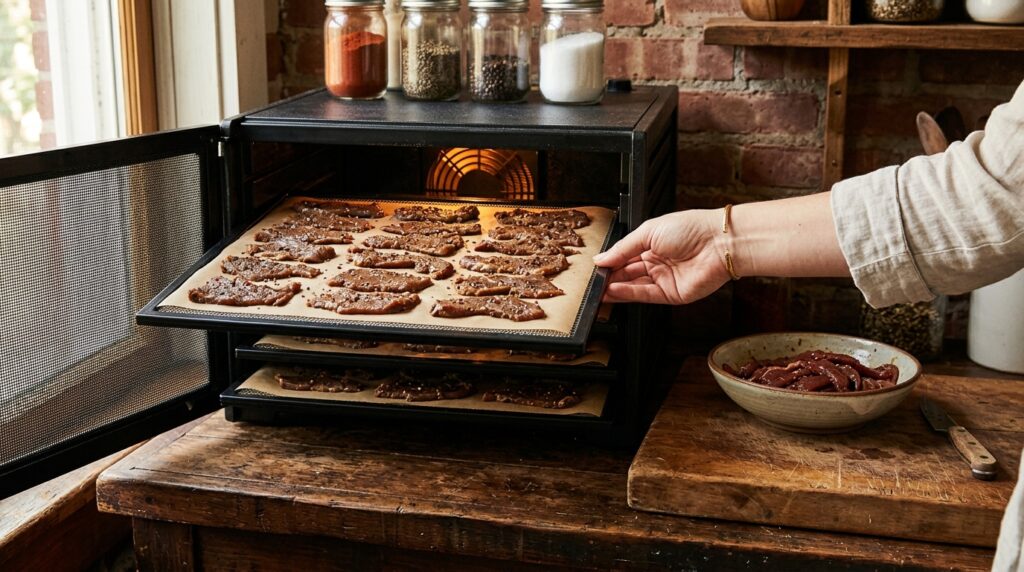
I’ll answer this the same way I’d answer a neighbor standing in my garage while I’m rotating trays of venison: yes, a food dehydrator is usually worth getting if you plan to make jerky more than a few times a year. If you just want to dry apple slices once every fall, probably not. But if you care about consistent texture, safer low-and-slow drying, and not babysitting your oven for six to ten hours, a dehydrator earns its shelf space fast.
That answer comes from ruining enough batches to stop pretending all drying methods are equal. I’ve made jerky in cheap stackable units, better horizontal-flow machines, and a regular oven in a pinch. The oven worked. The dehydrator worked better, used space more efficiently, and gave me fewer “done on one side, still tacky on the other” headaches. That difference matters if you’re trying to turn lean eye of round into good jerky instead of an expensive lesson.
The Short Answer
Is It Worth Getting A Food Dehydrator? For most home jerky makers, yes. A real dehydrator gives you controlled airflow, a more reliable temperature range, and repeatable results that are hard to match with an oven. Iowa State University Extension notes that dehydration removes roughly 80% to 95% of moisture and says an electric dehydrator is best for results. The National Center for Home Food Preservation also recommends models with an adjustable thermostat and enough tray area to dry food in a single layer, which is exactly what matters for jerky texture and batch efficiency.
That does not mean every household should buy one. If you make jerky twice a year, have a convection oven you trust, and do not mind tying it up half the day, you can get by without a dedicated machine. But if you make jerky monthly, hunt, buy meat in bulk, garden, or want better control than “crack the oven door and hope,” a dehydrator is one of the few kitchen gadgets that can actually save money and frustration over time. Even the bigger market data reflects that more people are deciding the same thing: one industry estimate pegged the global food dehydrator market at $2.60 billion in 2024, with continued growth ahead. Popularity alone does not make a tool useful, but it tells you this is not some weird niche garage habit anymore.
What Actually Matters When Buying for Jerky
If your main goal is jerky, don’t shop like you’re buying a cute fruit-snack gadget. Jerky asks more from a machine than herbs or banana chips do. You need even airflow, enough capacity to avoid overcrowding, and simple cleanup after marinade drips. These are the four things I’d judge first, ahead of flashy presets or a digital screen.
- Airflow design matters more than marketing. Horizontal-flow dehydrators push air across every tray more evenly and cut down on flavor transfer. Iowa State points out that horizontal units have less chance of mixing flavors when drying different foods at the same time. For jerky, that same side-to-side airflow usually means fewer tray rotations and less uneven drying.
- Usable tray space beats tray count. The National Center for Home Food Preservation notes that some models are expandable and that about 12 square feet of drying space can handle a sizable load at once. For me, that translates to a practical question: can this machine dry a full batch of sliced beef in one layer, or am I stacking pieces too close and slowing everything down?
- Adjustable temperature is not optional. The same extension guidance says most dehydrators are designed to dry foods fast at about 120 to 140 degrees F, but jerky gear should let you work confidently in that zone instead of locking you into one weak heat setting. A unit with real controls is easier to match to thinner or thicker cuts and easier to troubleshoot when a batch is finishing too brittle.
- Cleanup and tray design affect whether you’ll actually use it. This sounds boring until you scrub sugary teriyaki drips out of a cheap plastic grate at 10 p.m. Removable trays, decent spacing, and available liner sheets matter. My rule is simple: if cleanup is annoying, the machine gets used once, then lives in a basement tote.
One more point that gets missed in a lot of listicles: nutrition and quality are not one-size-fits-all across drying methods. A 2020 study comparing radiant energy vacuum drying, freeze drying, and air drying found that the method changed drying time, nutrient retention, and sensory quality depending on the food being dried; the faster process preserved some qualities better than conventional air drying in those tests (PubMed). A broader 2022 review on dehydration methods reached a similar practical conclusion for home users: drying method and temperature both influence nutrient retention, color, texture, and rehydration quality (PubMed). Translation into plain English: the machine and settings do matter. For jerky, you’re buying consistency more than you’re buying magic.
My Top Picks or Buying Tiers
I think of food dehydrators in tiers, not “best overall” fluff. The right buy depends on how often you make jerky, how much counter space you can spare, and whether you’re drying two pounds of beef or a deer’s worth over a season. Here’s the breakdown I’d actually use with a friend.
- Best value starter tier: a solid mid-size horizontal-flow unit or a proven stackable workhorse like a Nesco Snackmaster Pro food dehydrator. This is the sweet spot for most people. You get enough capacity for regular jerky without committing to a huge stainless box.
- Best long-term home jerky tier: a larger horizontal unit with square trays and stronger airflow, such as an Excalibur 9-tray food dehydrator. If you make jerky a lot, this is where convenience starts paying you back in time and fewer tray swaps.
- Best for occasional users: keep using your oven until your habit proves itself. If you are not making jerky at least every month or two, the smartest “purchase” may be no purchase yet.
- Worst value tier: the ultra-cheap round units with weak airflow, vague temperature labels, and flimsy trays. They can work, but they are the most likely to create uneven batches and the fastest route to “maybe homemade jerky just isn’t worth it.”
Here’s the buying table I wish more articles would show instead of dumping ten random models:
| Tier | Typical Price | What You Get | Main Tradeoff | Worth It? |
|---|---|---|---|---|
| Oven only | $0 extra if you already own one | Can dry jerky in a pinch | Ties up the oven, less even airflow, more babysitting | Yes for testing the hobby |
| Budget dehydrator | Usually under $80 | Basic drying, smaller footprint | Hot spots, lower capacity, more tray rotation | Only if budget is tight |
| Mid-range workhorse | Roughly $80-$180 | Good capacity, better control, repeatable jerky batches | Still not ideal for very large seasonal loads | Best value for most homes |
| Large horizontal unit | $200 and up | Batch efficiency, easier cleanup, stronger airflow | More cost, more space, harder to store | Yes if you make jerky often |
My biggest personal lesson here: I should have upgraded sooner. I spent too long trying to force a low-end unit to act like a serious jerky machine. It produced edible jerky, sure, but I lost time rotating trays, trimming around uneven pieces, and running batches longer than necessary. If you already know this is your hobby, buying once at the mid-range or better level is usually cheaper than buying twice.
Who Each Option Fits Best
Most people do not need “the best dehydrator.” They need the one that matches how they actually buy meat, prep batches, and use their kitchen. That is where the worth-it decision becomes clear.
- Buy a starter or mid-range unit if you make jerky at least six to ten times a year, buy lean beef when it goes on sale, or want to dry fruit, peppers, and herbs too. This is the practical family-use lane, and it is where most people get real value.
- Buy a larger horizontal model if you hunt, batch-cook, or hate doing second rounds. If your normal prep starts with five pounds of meat instead of two, tray space and even airflow are not luxuries. They are the whole game.
- Stick with the oven for now if you are still figuring out whether homemade jerky will become a habit. There is no shame in proving demand before buying equipment. I tell people this all the time because unused appliances are fake bargains.
- Skip the purchase entirely if your only motivation is “I heard dehydrating is healthy.” Plenty of dried snacks are useful, lightweight, and portable. The Smithsonian’s home dehydration handout adapted from NASA materials makes that point well for backpacking and storage uses (PDF). But the tool is only worth it if you will actually prep, dry, store, and eat what you make.
There’s also a money angle people tend to oversimplify. Yes, homemade jerky can save money compared with premium store-bought bags, especially when you buy lean cuts on sale and make larger batches. No, a dehydrator does not automatically create savings if you use expensive marinades, buy full-price steak, and run tiny test batches. Iowa State’s extension piece says the average fruit and vegetable chip run may cost less than a dollar in electricity, which helps, but the real economics for jerky come from batch size and meat price more than power use. I learned that the hard way after making a few “budget” batches from badly chosen cuts that trimmed down into very non-budget jerky.
Mistakes That Waste Money
The first money-waster is buying too small because the sticker price looks safer. Small units look like a bargain until you realize your three-pound batch now needs multiple rounds, crowded trays, or pieces laid half on top of each other. That slows drying, hurts texture, and pushes you toward the kind of inconsistency that makes people quit. The second money-waster is buying too fancy for your real use. If you make jerky twice a year, a premium stainless cabinet can turn into a very expensive dust cover.
The third mistake is assuming all dehydration is equal. Research reviews keep showing that drying method affects texture, color, and nutrient retention, and a 2024 review of osmotic dehydration also highlights how pretreatment changes moisture loss and finished quality depending on the product (PubMed). For jerky, the practical version is simple: your slicer habits, marinade load, strip thickness, tray spacing, and airflow all interact. I have absolutely over-marinated a batch, clogged the tray surfaces, and then blamed the machine when the real problem was me. Last mistake: ignoring food-safety guidance and trying to get cute with low heat, overloaded trays, or fatty cuts. A dehydrator is worth buying because it gives you more control, but only if you use that control like an adult and not like a guy trying to cram one more pound onto the racks.
Bottom Line
If you’re serious enough about homemade jerky that you’re asking whether the tool is worth buying, the answer is usually yes. A food dehydrator is worth it when you want repeatable batches, better airflow than an oven, and enough tray space to make lean meat purchases pay off. It is especially worth it for regular jerky makers, hunters, gardeners, and families who will use it for more than one food. If that sounds like you, aim for a solid mid-range machine first, and step up to a larger horizontal-flow unit if batch volume keeps growing.
If that does not sound like you, save the money and keep testing with your oven. The best buying decision is not always “buy the gadget.” But from one guy with a garage jerky setup to another practical shopper: once you cross from occasional experiment to real routine, a good dehydrator stops being a novelty and starts being one of the few kitchen tools that genuinely earns its keep.