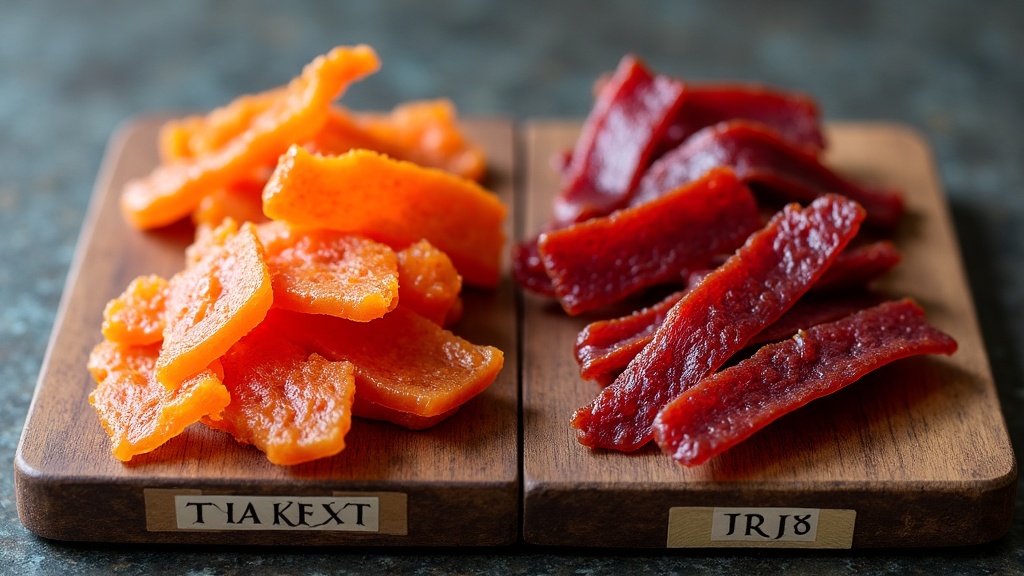
The jerky aisle has gotten complicated. Beef jerky used to be the only option. Now turkey jerky sits next to it on every shelf, positioned as the “healthier” choice — lower in fat, higher in protein per calorie, better for you. But is that reputation earned? And more importantly, is it actually better tasting?
I’ve made both extensively in my test kitchen and eaten embarrassing quantities of both in the field. Here’s an honest comparison from someone who cares about the science as much as the snacking.
Protein Comparison
Both beef jerky and turkey jerky are excellent protein sources — this is the one area where the marketing is largely accurate for both products.
Per 1 oz (28g) serving of typical commercial jerky:
- Beef jerky: 9–11g protein
- Turkey jerky: 10–13g protein
Turkey has a slight edge in protein density, primarily because commercial turkey jerky is almost always made from breast meat — a very lean cut. Beef jerky is made from a wider variety of cuts, and the protein content varies accordingly. Top round and eye of round beef jerky will be closer to turkey in protein content; jerky made from fattier cuts will be lower.
The protein quality (amino acid profile, digestibility) is comparable between the two. Both are complete proteins — they contain all nine essential amino acids in meaningful quantities. For muscle synthesis and satiety, either works equally well.
Bottom line on protein: Turkey wins slightly on protein per ounce, but the difference is small enough that it shouldn’t drive your choice.
Fat Content
This is where the real difference lives, and it’s significant.
Per 1 oz (28g) serving:
- Beef jerky: 3–7g fat (varies widely by cut)
- Turkey jerky: 0.5–2g fat
Turkey jerky made from breast meat is dramatically leaner than most beef jerky. If you’re managing fat intake for cardiovascular health or caloric restriction, this matters. A 3–4x difference in fat per serving adds up over a day of snacking.
However — and this is important — fat in jerky isn’t purely a liability. Fat carries flavor. The beefy, savory depth that characterizes great beef jerky comes largely from intramuscular fat and the Maillard reaction products it enables during drying. Turkey jerky, being nearly fat-free, needs to work harder with marinades and seasonings to achieve comparable flavor complexity.
Fat also affects shelf life. Fatty jerky goes rancid faster than lean jerky — it’s why traditional jerky recipes (especially biltong and pemmican) used the leanest possible cuts. Turkey jerky’s lower fat content is actually an advantage for longer storage, even beyond the health angle.
Bottom line on fat: Turkey wins decisively for low-fat eating. Beef wins for flavor derived from fat.
Texture Differences
This might be the most underappreciated difference between the two. Texture in jerky is about protein structure, fat distribution, and how the meat behaves during drying.
Beef jerky has a characteristic chew — substantial, fibrous, satisfying. The muscle fibers in beef are longer and denser, and the fat marbling means the dried product retains some pliability. Good beef jerky bends before it breaks and offers resistance when you bite into it. This is what most people picture when they think “jerky.”
Turkey jerky is more tender and less chewy. Turkey breast has shorter muscle fibers and almost no fat, which means it dries into a more delicate texture that can be almost crispy if overdried. Well-made turkey jerky is pleasant — but it doesn’t have the same satisfying resistance that beef jerky delivers. Some people prefer this; many don’t.
The texture difference also affects how each type responds to different preparation methods. Whole-muscle beef jerky shines. Whole-muscle turkey jerky can be excellent with the right technique. Ground meat (jerky-gun) applications work better with beef, where the fat helps bind the mixture and maintain texture. Ground turkey jerky tends toward dry and crumbly.
Prep Differences: Turkey Dries Faster
This is the practical detail that trips up a lot of home jerky makers.
Turkey breast is leaner and has a different fiber structure than beef. It dries significantly faster in a dehydrator — typically 20–30% faster than comparable beef. A batch of beef jerky that takes 6–8 hours might be done in 4–5 hours with turkey.
Overdried turkey jerky is almost inedible — hard, brittle, and flavor-depleted. You need to check turkey more frequently, especially in the final hour of drying.
The best setup for monitoring is a quality food dehydrator with a built-in timer and adjustable temperature. Set it at 155°F (68°C) for poultry — this is the USDA-recommended minimum temperature for turkey to ensure pathogen kill. Beef can be done at lower temperatures with a pre-heat step, but turkey should always hit 165°F internal temperature.
Slicing turkey consistently is another challenge — it’s softer than beef before drying and can be harder to cut evenly by hand. A meat slicer makes a significant difference in getting uniform thickness, which is the key to even drying.
Flavor Profile
Taste is subjective, but flavor chemistry is not.
Beef has a higher concentration of glutamates, inosinate, and guanylate — the compounds responsible for umami flavor. When beef dries, these concentrate, which is why quality beef jerky has that deep, savory satisfaction that’s hard to replicate with other proteins.
Turkey is milder. The base flavor of turkey breast is relatively neutral — it’s a blank canvas. This isn’t a flaw; it means turkey jerky takes on marinade flavors more readily and completely than beef. A teriyaki turkey jerky can be intensely teriyaki because the turkey isn’t competing with the marinade. A teriyaki beef jerky will always have the beef flavor underneath.
For sweet, saucy, or heavily spiced jerky styles (teriyaki, honey sriracha, Korean BBQ), turkey often produces a cleaner expression of the marinade flavor. For classic, savory, smoke-forward styles (cowboy blend, black pepper, smoke and salt), beef wins decisively.
A jerky gun opens up another dimension for both types — ground turkey can be seasoned aggressively to compensate for its mild flavor, and the uniform strips it produces dry more evenly than hand-cut pieces.
Best Use Cases
Choose beef jerky when:
- You want maximum flavor satisfaction from the meat itself
- You’re eating it plain or with minimal seasoning
- Texture and chew matter to you
- You’re sharing with people who just want “jerky” and aren’t tracking macros
- It’s a meal component (charcuterie boards, camping food)
Choose turkey jerky when:
- You’re managing fat or calorie intake
- You want the marinade flavor to be the star
- You prefer a more tender texture
- Longer shelf life is a priority
- You’re cooking for someone who doesn’t eat red meat
The Verdict
Is turkey jerky healthier? Yes, meaningfully so — lower fat, comparable protein, and genuinely suitable for more dietary patterns. If health metrics are your primary consideration, turkey is the winner.
Is beef jerky better tasting? For most people, in most applications, also yes. The depth of flavor that comes from beef’s fat content and higher umami compound concentration is hard to replicate. It’s not even close for classic savory applications.
The real answer is that these aren’t competing products — they’re complementary ones. I keep both in rotation depending on what I’m making and why. A classic smoked black pepper jerky uses beef. A teriyaki jerky for someone watching their diet uses turkey. A camping trip gets beef for the energy density; a post-workout snack gets turkey for the protein-to-calorie ratio.
Both are significantly better than most commercial jerky when made at home with quality ingredients and proper technique. Start there, and the beef vs. turkey debate becomes a fun choice rather than an important one.
— Sam | Food Scientist & Amateur Butcher

