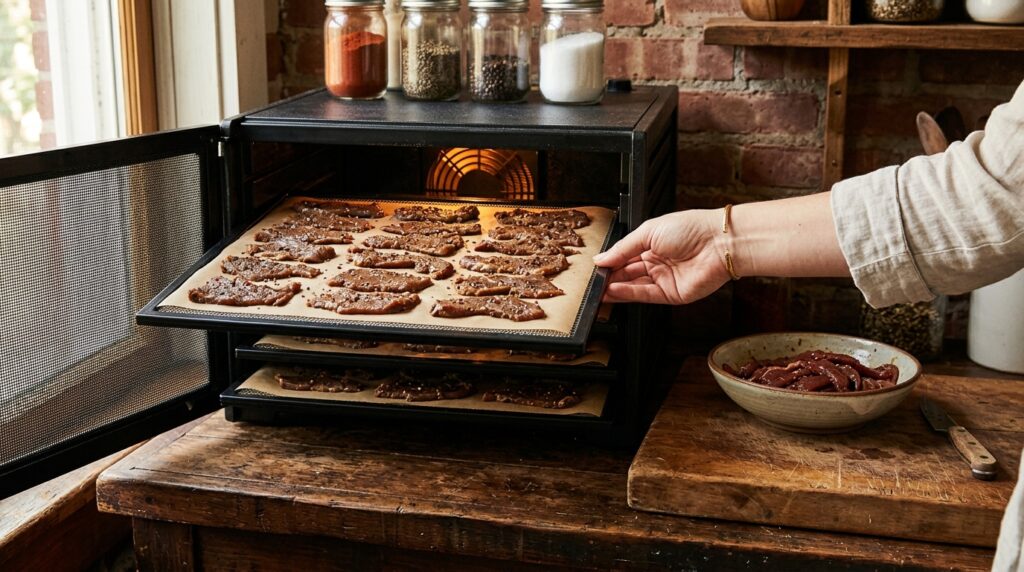
I have had batches come out dry, shiny, and good-looking while still making me uneasy, so let me answer this straight: yes, bacteria can grow in a dehydrator early in the process if the food spends too long in the temperature danger zone, and some bacteria can also survive dehydration if your process never gets them to a lethal temperature. A dehydrator is a drying tool, not a magic sterilizer.
That is the part a lot of homemade jerky guides dance around. Drying eventually lowers water activity enough that bacteria stop growing, but “stop growing” is not the same as “were killed.” Research on dried foods says low-moisture products are often assumed to be automatically safe when they are not, and a 2018 review noted dried foods typically fall in a water activity range of 0.03 to 0.7 and are not inherently microbiologically safe. If you make jerky at home, the smarter question is not just whether bacteria can grow in a dehydrator, but what gear and process choices keep that from happening.
The Short Answer
Yes, bacteria can grow in a dehydrator while the meat is still moist and warming up. After enough moisture is removed, growth slows or stops, but that does not mean the bacteria were killed. USDA FSIS warns that when raw meat or poultry is dehydrated, pathogens can survive the dry heat of a dehydrator, and as the product dries, bacteria can become more heat resistant rather than less (FSIS jerky guidance).
That is why the safest home setup is not the cheapest dehydrator on the shelf. It is the one that gives you enough temperature control, airflow, batch capacity, and process visibility to get the meat heated properly before or during drying. Kansas State’s dehydration guidance makes the same basic point from the other side: drying removes moisture, which slows spoilage and growth, but it does not by itself make food sterile (K-State). In plain English: the right purchase is the one that helps you run a safer process, not the one with the prettiest marketing photos.
What Actually Matters When Buying for Jerky
If you mostly dry apple rings, you can get away with almost any decent machine. Jerky is less forgiving because you are dealing with raw meat, wet marinades, thicker strips, and a narrow line between “properly dried” and “I hope this is fine.” After 400-plus batches, these are the buying factors I care about most.
- Real temperature control: You want a dehydrator that can reliably run in the jerky range, not a vague warm-air box with one switch. FSIS and extension guidance exist for a reason: inadequate heat treatment is where safety problems start.
- Airflow that dries evenly: Uneven trays mean some strips dry too fast and others stay damp too long. That is not just annoying texture-wise. It stretches the time certain pieces spend in the risk zone.
- Enough capacity for thin single-layer spacing: Overcrowding trays saves nothing. Meat touching meat slows drying, traps wet spots, and turns a six-hour batch into an all-day guessing game.
- A separate thermometer and a process you can repeat: A dehydrator dial is not a food-safety verification tool. A fast probe thermometer is cheap insurance, especially if you preheat or finish strips in the oven.
One lab finding that matters here: a study on air drying showed several bacteria lost viability under desiccation stress, but survival changed depending on the organism and the surrounding compounds (Nocker et al.). Another older PubMed study found bacterial survival in dry conditions improved in the presence of proteins such as albumin (Hiramatsu et al.). That tracks with the real-world jerky problem: meat is a protein-rich surface, not a sterile science dish. I learned this the hard way on an early venison batch when I packed thick strips too close together, trusted the dial, and ended up with a tray that dried on the edges but stayed tacky in the middle. It did not make anyone sick, but it went straight in the trash. Cheap batch economics disappear fast when you have to throw away three pounds of top round.
My Top Picks or Buying Tiers
For this topic, my “top picks” are not random gadgets. They are the tools that make it easier to keep bacteria from growing early, easier to hit a safer jerky process, and easier to avoid wasting meat. If you already own a dehydrator, start with the thermometer. If you are buying from scratch, buy for control first and capacity second.
| Tier | What I’d Buy | Why It Helps With Safety | Best For |
|---|---|---|---|
| Budget starter | NESCO FD-75A Snackmaster Pro | Adjustable temperature and expandable trays give you more control than bargain no-name units. | New jerky makers who want solid results without overspending. |
| Best upgrade | COSORI Stainless Steel Food Dehydrator | Rear fan and box-style layout help even drying, which reduces tray babysitting and wet spots. | People making frequent family-size or hunting-season batches. |
| Must-have safety tool | ThermoPro TP19H Instant-Read Thermometer | Lets you verify meat temperature instead of assuming your dehydrator dial is accurate. | Everyone, especially if you preheat meat or finish in the oven. |
| Optional precision buy | Tagged Amazon search for food water activity meters | Useful if you sell, gift, or obsessively document batches and want to judge dryness more objectively. | Advanced hobbyists, cottage-food tinkerers, and repeat batch testers. |
- Best value: The NESCO is still the practical starter pick because it gives home users real temperature adjustment without forcing a big upfront spend. I would rather see a beginner buy this plus a thermometer than blow the whole budget on a prettier machine and skip temperature verification.
- Best all-around upgrade: The COSORI box-style units make workflow cleaner. Rear airflow tends to be more even, the trays are easier to load with marinated strips, and cleanup is usually less of a fight after a sticky teriyaki batch.
- Best safety buy per dollar: The thermometer matters more than most accessories. One of my more expensive mistakes was assuming a machine set to 160°F meant the meat itself was where I needed it. It did not.
- Best optional nerd tool: A water activity meter is overkill for most home cooks, but if you are constantly pushing lower-salt recipes, very thick strips, or long storage times, it gives you a more objective way to compare batches.
The evidence supports this safety-first gear hierarchy. Reviews of dried foods note that low moisture reduces microbial growth potential, but pathogenic contamination can still matter, especially when drying is the only hurdle (PubMed review). A broader review of dried-food microbiology also notes that drying methods differ in how effectively they reduce microbial load (PMC review). So if you are trying to spend wisely, spend on the machine and tools that make your process repeatable.
Who Each Option Fits Best
Different setups make sense for different homes. I have kids running through the kitchen, limited counter space, and a garage table that turns into jerky central on weekends, so my “best” is always tied to how someone actually cooks.
- The budget stacker fits the occasional batch maker: If you make jerky once a month, want decent control, and do not need stainless steel everything, a solid stacker is enough. Keep slices thin, avoid overload, and rotate or monitor if your model runs uneven.
- The box-style upgrade fits the repeat hobbyist: If you do bigger beef rounds, venison season, or mixed family snack batches, a rear-fan box machine is easier to manage and usually more consistent tray to tray.
- The thermometer fits the cautious beginner and the stubborn veteran: I put myself in the second camp. The more batches you make, the easier it is to get lazy. A quick temperature check keeps confidence from turning into sloppiness.
- The water activity meter fits the process geek: If you track marinade ratios, slice thickness, finished weights, and storage times, this is the tool that turns “feels dry enough” into actual batch data.
If you are wondering whether you can skip all that and just buy curing salt, I would not build my safety plan around one ingredient. Salt, sugar, acidity, heat, airflow, slice thickness, and final dryness all work together. Food-safety people call that hurdle technology. Home jerky makers usually call it “the batch that finally came out right.” My practical rule is simple: buy the machine that helps you dry evenly, buy the thermometer that helps you verify heat, and treat the marinade as a supporting player, not a magic shield.
Mistakes That Waste Money
The biggest money-waster is buying a dehydrator by tray count alone. More trays sound great until you realize the unit has weak airflow, sloppy temperature control, or both. Then you are rotating trays every hour, drying half the batch twice as long, and tossing the thick pieces because they still feel soft in the center. On a cheap cut that is annoying. On a big eye of round or venison batch, that is real money in the trash. Ohio State’s jerky guidance is blunt that dehydrator and oven temperatures alone may not be high enough to destroy harmful microorganisms in raw meat (Ohio State Extension). So a machine that only “sort of” runs hot enough is not a bargain.
The second mistake is thinking dryness equals safety at every stage. It does not. FSIS notes that as meat dries, bacteria may become more heat resistant, which is exactly backward from what many people assume (FSIS). I also see people overspend on accessories and underspend on meat handling basics: a sharp slicing knife, good tray spacing, clean hands, cold marinating, and fast transfer from fridge to heat. Another bad buy is the mega-capacity unit for someone who only makes one-pound batches. Bigger is not always cheaper if it means longer preheat time, more cleanup, and a machine you stop using. Buy for the batch size you will actually run six times a year, not the fantasy elk season you talk about at the hardware store.
Bottom Line
So, can bacteria grow in a dehydrator? Yes, especially before the food has dried enough to limit growth, and yes, bacteria can survive the process if your setup never delivers an adequate lethality step. The safe-home-jerky move is to stop treating the dehydrator like the whole solution. It is one piece of the solution. The better buy is the gear that gives you control: a dehydrator with a real thermostat, airflow that dries evenly, and a thermometer that lets you verify what the meat is actually doing.
If you want the shortest version of my buying advice, it is this: start with the NESCO FD-75A if you need value, step up to the COSORI stainless dehydrator if you make jerky often, and do not skip an instant-read thermometer like the ThermoPro TP19H. I would rather own modest gear I trust than expensive gear I have to guess with. That rule has saved me more meat than any marinade recipe ever has.