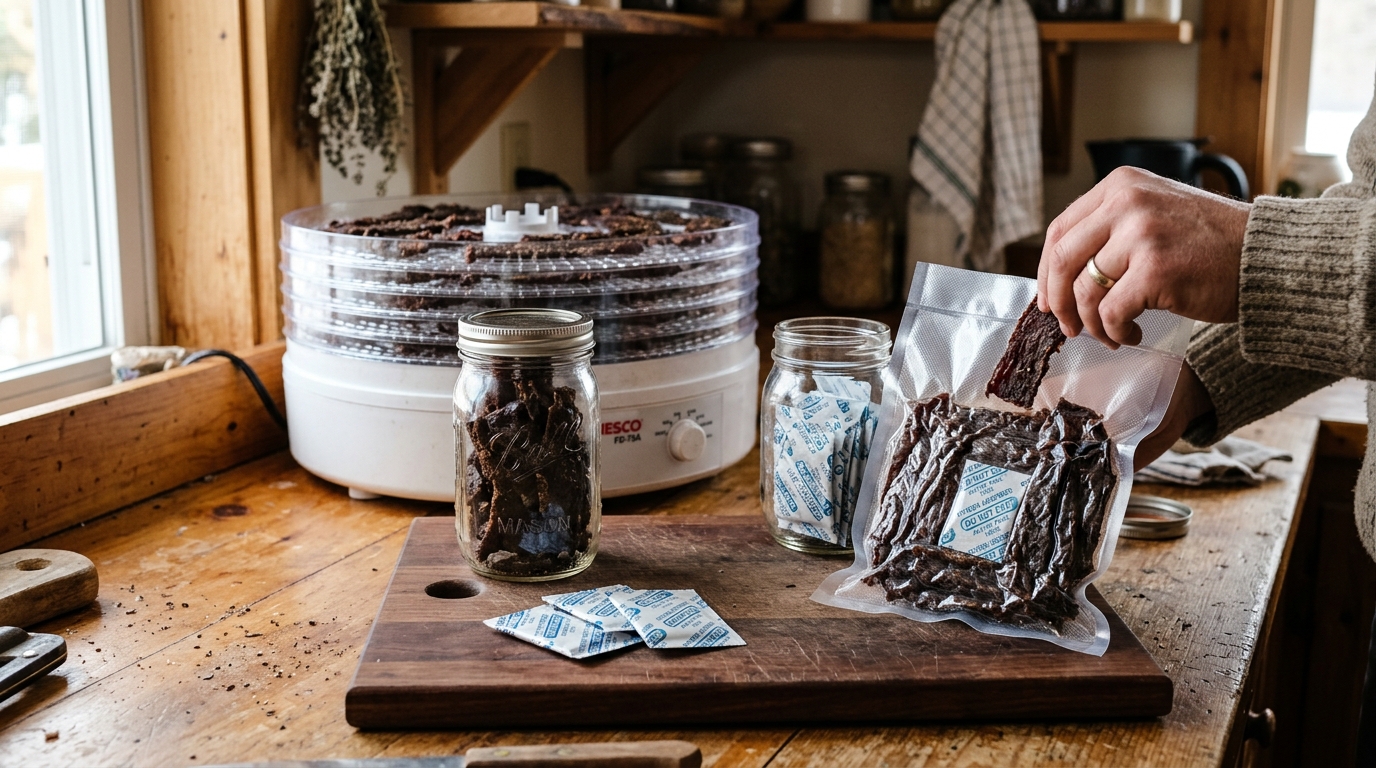
I buy jerky oxygen absorbers only after deciding whether the jerky belongs in an oxygen-reduced package. They can help protect properly processed, sufficiently dry jerky from oxidation. They cannot make moist homemade meat safe on a pantry shelf, and removing oxygen from moist meat can create conditions for botulism. That distinction matters more than the brand printed on the packet.
If you are trying to get a batch right without wasting good meat, I’m Sam, a Milwaukee dad of three with eight years and more than 400 batches behind my garage jerky lab. My buying rule is simple: spend money on the process before the packaging extras. Here is how I decide whether absorbers earn a place in a batch, what I look for on the listing, and when I keep my wallet closed.
The Short Answer
Use oxygen absorbers as a quality-preservation tool for jerky whose processing and dryness already support the intended storage conditions. Their useful job is reducing oxygen that contributes to stale flavors, fat oxidation, and growth of oxygen-dependent molds. They need suitable barrier packaging and a sound seal. Dropping one into a sandwich bag does not establish a safe shelf life.
If you cannot establish that your homemade jerky is suitable for reduced-oxygen storage, skip the absorber and refrigerate or freeze promptly. Follow a tested home-jerky process and its storage instructions. The National Center for Home Food Preservation’s jerky guidance gives two weeks at room temperature for properly dried jerky in a sealed container and recommends refrigeration or freezing for better keeping quality. That is not a promise for underdried meat, nor permission to add months by adding a packet.
The moisture boundary you cannot judge by chewing
Utah State University Extension warns that moist foods in oxygen-reducing packaging can pose a botulism risk. Its general dry-food storage advice specifies about 10% moisture or less for foods stored airtight with absorbers. Do not translate that into a home-jerky drying time or a percentage of weight lost: moisture content and water activity measure different things.
Water activity describes how available water is for microbial growth. A bend test can help assess texture, but it does not measure water activity. Neither does weighing a roast before and after drying. A dry outside can also hide a wetter center, especially when slices vary in thickness. Comfortable chewing and microbiological stability are separate questions.
USDA’s commercial jerky guidance discusses a water-activity limit of 0.85 or lower for aerobic storage, with mold controls, and a different limit under specified anaerobic packaging conditions. Those are parts of a supported production process, including pathogen reduction and packaging controls. They are not a home shortcut for putting soft jerky in a bag with an absorber. If you need a defensible room-temperature product, get help from an Extension food specialist or food laboratory with process assessment and representative water-activity testing.
What Actually Matters When Buying for Jerky
Once the batch qualifies for the storage method, shop for a compatible system: absorber, container, closure, and portion size. A large capacity number is only one part of that system. These are the four listing details I would check before comparing price.
- Food use and application: Buy packets explicitly intended for food packaging and suitable for dry foods such as jerky. Require an identifiable manufacturer and handling instructions.
- Oxygen capacity: The cc rating describes oxygen uptake, not the weight of meat the packet protects. Match it to the air remaining throughout the package.
- Small sealed groups: Individually wrapped packets or small factory-sealed groups make sense when you package only a few portions per session.
- Barrier and seal requirements: Check the bag material and required sealing method. A zipper, metallic appearance, or thick feel alone does not establish oxygen-barrier performance.
Absorber chemistry matters, too. Mitsubishi Gas Chemical distinguishes different absorber types, including self-reacting products. Some formulations depend on moisture from the food. Ask the supplier whether the specific packet works at your product’s water activity and storage temperature. Do not moisten jerky or add water to activate an unsuitable packet.
How much capacity do you need?
IMPAK’s sizing explanation defines a 300cc absorber as having capacity for 300 cubic centimeters of oxygen. Air is roughly 21% oxygen. Both the headspace above the jerky and the spaces between strips count. A loosely filled bag needs more capacity than a tightly packed bag of the same dimensions.
For a simple illustration, an empty one-liter container holds approximately 210cc of oxygen in ordinary air. Filling it with jerky reduces that amount. A 300cc packet therefore exceeds that container’s initial oxygen load on paper, but this calculation does not establish performance, absorption speed, seal integrity, or food safety. Follow the supplier’s sizing guidance and allowance for your actual packaging.
I would rather reduce needless bag space than keep buying enormous packets. Use a package that fits the portion without forcing sharp jerky edges against the film. Extra absorber capacity cannot compensate indefinitely for air entering through a poor seal.
Oxygen absorber versus silica gel
An oxygen absorber removes oxygen; a desiccant such as silica gel removes moisture. They are different tools. A desiccant is not a way to finish drying meat inside its storage bag, and it does not replace an absorber. Avoid buying an assortment labeled simply “freshness packets” unless the contents and intended applications are clear.
My Top Picks or Buying Tiers
My shortlist is based on the job, rather than a brand ranking. I am not claiming that one retail packet has passed a garage shelf-life trial. For most households, the best value starts with buying fewer accessories and packaging smaller portions.
- Tier 1 ? ordinary cold-storage supplies: For home batches with unverified shelf stability, buy suitable refrigerator or freezer containers and skip oxygen absorbers.
- Tier 2 ? small packs of food-use absorbers: For eligible dry jerky, choose documented packets in sealed quantities close to the number of bags you fill at once.
- Tier 3 ? absorbers plus high-barrier pouches: For eligible batches that will remain unopened, pair correctly sized packets with documented food-grade barrier pouches and an appropriate heat seal.
- Tier 4 ? testing before bulk packaging: For repeatable pantry storage, gifts, or a growing operation, prioritize qualified process advice and water-activity testing before a case of supplies.
As an Amazon Associate, I earn from qualifying purchases. For category shopping, compare individually sealed food-grade oxygen absorbers in 100cc to 300cc sizes. Those sizes are candidates to evaluate, not a universal prescription. Reject listings that omit application instructions or make sweeping shelf-life claims for homemade meat.
| Buying option | Best reason to choose it | Main limitation |
|---|---|---|
| Freezer-rated bags or containers | Simple portions for ordinary home batches | Need continued cold storage |
| Small sealed absorber packs | Less unused capacity exposed during occasional packing | Require suitable dry food and barrier packaging |
| Heat-sealable barrier pouches | Protect eligible unopened portions from incoming oxygen and moisture | Need documented material performance and reliable sealing |
| Professional testing and process advice | Support an informed shelf-stability decision | One sample does not represent every recipe and future batch |
For the third tier, compare food-grade heat-sealable high-barrier Mylar pouches. Ask for oxygen-transmission information when it is missing. IMPAK’s packaging guidance emphasizes low oxygen transmission and dependable seals; even a small leak can defeat the packet. Also check equipment compatibility before buying: a smooth pouch may require a different sealing setup from an embossed vacuum bag.
Compare cost per usable packet
Here is the math I use for small-batch supplies. Suppose a hypothetical 100-pack costs $12, but poor leftover handling means only 20 packets get used while reliable. That is 60 cents per usable packet. A hypothetical 20-pack costing $6 in small sealed groups works out to 30 cents each if all are usable. These are examples, not current prices, but they explain why the biggest bag can be the worse buy.
Who Each Option Fits Best
Start with how your household eats the jerky. With three kids, I care more about useful portions than a giant package that looks economical. Every opening introduces fresh air, so repeatedly opening one jar undermines the purpose of creating a low-oxygen environment.
- The weekend batch maker: Refrigerate the portion you will eat soon and freeze the surplus. An absorber purchase often adds little value.
- The softer-jerky fan: Choose prompt cold storage and a tested process. Do not assume a tender, moist batch can live in the pantry because commercial tender jerky does.
- The maker with an established shelf-stable process: Small absorber packs and properly sealed barrier pouches can help protect unopened portions from oxidation.
- The gift giver or trip planner: Establish storage needs before packing. If the batch requires refrigeration, provide clear instructions and maintain cold storage during transport.
My cost-saving preference starts at the meat counter: lean eye of round or well-trimmed top or bottom round makes more sense than paying for marbling I will cut away. An absorber is no excuse to leave thick seams of fat. Compare usable trimmed meat, not just the sticker price per pound, and reserve expensive packaging for portions that benefit from it.
A practical packing sequence
- Complete the safe process first. USDA recommends heating meat to 160°F and poultry to 165°F before dehydration. Follow its jerky safety guidance; the dehydrator’s dial is not an internal-temperature measurement.
- Finish drying and cool before packing. Do not trap steam. Keep handling clean and avoid leaving the finished batch out for hours while organizing supplies.
- Choose storage before adding packets. If suitability for reduced-oxygen storage is uncertain, skip absorbers and promptly refrigerate or freeze.
- Prepare eligible portions and labels first. Include the batch date and applicable storage instructions. Keep crumbs and oil out of the sealing area.
- Open only the absorbers needed. Insert intact packets and seal within the manufacturer’s exposure limit. Immediately protect unused packets exactly as directed.
- Inspect the closure. Look for wrinkles, trapped meat, incomplete seals, and punctures. Keep packets away from children and remove them before serving.
Do not use a tightly drawn-in bag as your acceptance test. Absorbers remove oxygen, while much of the original air is nitrogen, so a package need not become vacuum-tight. Likewise, an indicator supplied with the packets only reports its specified oxygen condition; it cannot verify the meat’s safety.
Mistakes That Waste Money
Buying preservation claims instead of a process. “Keeps food fresh for years” on a dry-goods listing says nothing useful about your teriyaki batch. Salt, sugar, curing ingredients, heat treatment, drying, and packaging all affect the finished product. Adding extra curing salt or drying for an arbitrary extra hour is not a substitute for a tested method.
Trying to buy back texture after overdrying. My preference is to improve slicing consistency and check pieces individually as they finish. For a gentler chew, cutting across the grain is a more sensible starting point than deliberately leaving a wet center. Never add a damp towel, bread, or another moisture source to a sealed jerky package intended for pantry storage.
Other expensive shortcuts
Do not reuse a packet from a store-bought jerky bag: its remaining capacity is unknown. Do not assume a warm packet is fully effective or a cool packet is exhausted; follow the manufacturer’s checks. Leaving a supply bag open while you finish packing spends capacity on room air. Refrigeration afterward does not restore it.
Most importantly, do not taste questionable jerky to decide whether an absorber worked. CDC explains that botulinum toxin cannot be seen, smelled, or tasted. Discard jerky with mold or other spoilage, and discard moist homemade jerky that has been held at room temperature in reduced-oxygen packaging without an established safe process. Freezing later does not undo unsafe storage.
Bottom Line
For most home makers, my first buy is good cold-storage packaging. For jerky with an established suitable process, my absorber pick is a small sealed supply with clear instructions, matched to a reliable barrier package. Spend on usable packets, sensible portions, and sound seals before chasing a bigger cc number.
Jerky oxygen absorbers can help protect the quality you already made. They cannot establish dryness, kill pathogens, or award a homemade batch a commercial shelf life. If the moisture question is unresolved, keep the packets out, use cold storage, and put the next dollar toward improving the process.

