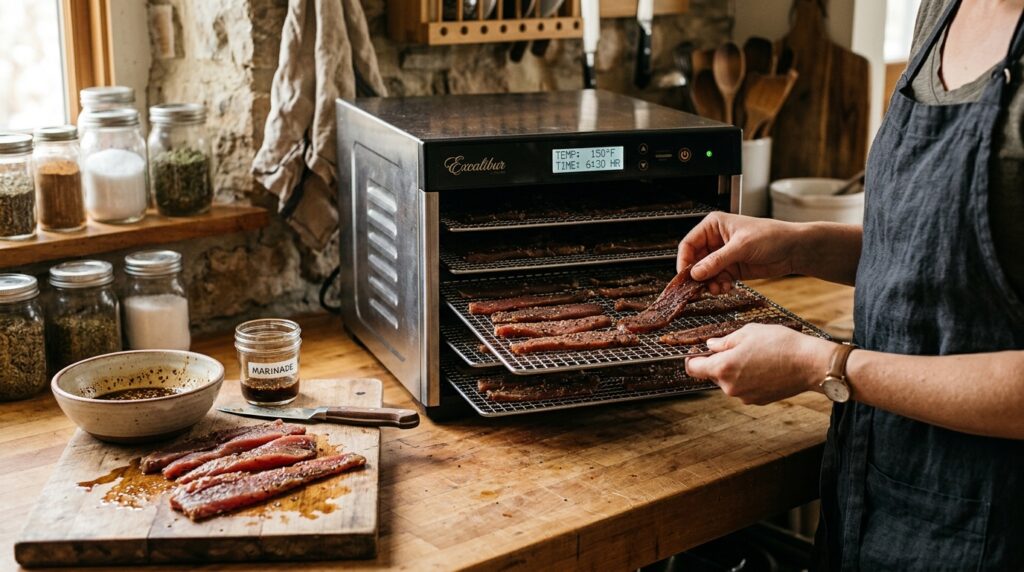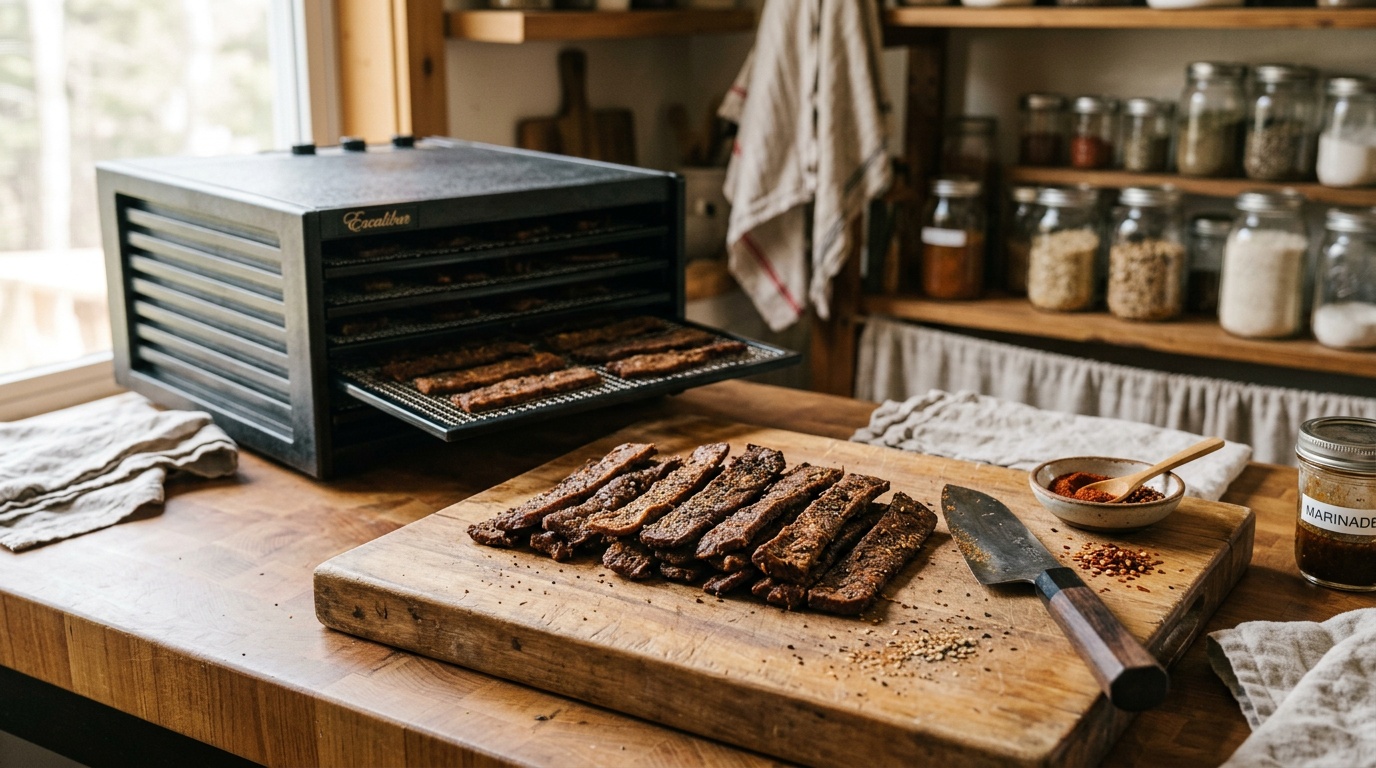
I start tofu jerky with extra-firm tofu, even quarter-inch slices, and a dehydrator set to 150°F. The trick is removing enough water for a firm chew without drying every strip into a cracker. After eight years and 400-plus jerky batches in my Milwaukee garage setup, I still trust a cooled sample more than the timer.
This tofu jerky recipe for a dehydrator uses one block and a smoky, savory marinade. It also gives you a way to diagnose the usual disappointments: soft middles, brittle edges, bland centers, and sticky surfaces. Tofu will not develop beef’s muscle fibers, but it can make a satisfying, chewy vegan snack without an expensive ingredient list.
The Short Answer
Press extra-firm tofu, slice it ¼ inch thick, marinate in the refrigerator for four hours, and dehydrate at 150°F until dry and chewy. Plan around six hours of drying, start checking at four hours, and allow extra time for wetter tofu or a crowded machine. Timing is a planning estimate, not proof that every piece is finished.
The UC Cooperative Extension tofu jerky method provides the basic preparation and drying baseline. The seasoning below is a simple starting formula. Treat this homemade chewy version as a refrigerated food: a bend test tells you about texture, but does not establish shelf stability.
Ingredients for one block
- One 14- to 16-ounce block extra-firm tofu, drained
- 3 tablespoons reduced-sodium soy sauce, or gluten-free tamari if needed
- 1 tablespoon water
- 1 tablespoon maple syrup
- 1 tablespoon apple cider vinegar
- 1 teaspoon smoked paprika
- ½ teaspoon each garlic powder and onion powder
- ¼ teaspoon black pepper
- Optional: ¼ teaspoon liquid smoke or a pinch of cayenne
Expect a small snack batch, roughly three or four portions, rather than a full bag for everyone in the house. Finished weight varies with the tofu and how far you dry it. This marinade needs no added oil; tofu already contains fat, and extra oil can leave the surface greasy. Regular soy sauce works, but produces a saltier result. Check sauce labels if you need the whole batch gluten-free.
This article contains affiliate links. As an Amazon Associate, I earn from qualifying purchases.
What Is Causing the Problem
Tofu is a network of soy proteins holding water. Dehydration removes that water and tightens the structure. A thick or poorly pressed strip can stay soft inside while its edges become tough. Unlike the lean beef cuts I usually work with, there is no grain direction to choose and no fat cap to trim. Your main controls are starting moisture, thickness, and drying time.
- Soft, almost custardy centers: The starting tofu was too soft, the slices were too thick, or the center has not dried enough.
- Brittle edges and a hard bite: Thin pieces finished before the others, or the whole batch stayed in too long.
- Sticky surfaces: Excess maple syrup or a thick coating of marinade can remain tacky even after substantial drying.
- Uneven texture across one tray: Inconsistent slicing, overlapping strips, or uneven airflow gives different pieces different drying conditions.
Salt and sweetness become more noticeable as water leaves. That is why pouring in more soy sauce to fix a bland center can produce salty edges instead. My first adjustment is thinner, more uniform slicing and complete marinade contact. More seasoning comes after that.
Choose the tofu for the chew you want
| Tofu type | What to expect | Best decision |
|---|---|---|
| Water-packed extra-firm | Dense strips after pressing; a useful starting point | Use for the first batch |
| Vacuum-packed super-firm | Less starting water and a dense bite; may finish sooner | Check early and avoid excessive pressing |
| Frozen, thawed extra-firm | More porous, springy texture that holds marinade readily | Try when you want a rougher, sponge-like chew |
| Soft or silken | Fragile slices that break during handling | Save for another dish |
Freezing changes the structure because ice crystals leave larger spaces behind when they melt. That can make tofu feel meatier to some people and too spongy to others. It is optional. For a useful comparison, master the unfrozen version first; otherwise you are changing both the ingredient structure and the drying process at once.
How I Fix It Batch to Batch
I keep the first run deliberately boring: one block, one thickness, one marinade. With three kids and limited tray space, I would rather learn from a small batch than discover that four blocks all taste like salty shoe leather. Scale up after you have a texture you actually like.
- Press gently: Put drained tofu between clean towels on a plate, add another plate and a modest weight, and press for 25–30 minutes. Stop if the block starts splitting. Pressing in the refrigerator makes it easier to keep the tofu cold during preparation.
- Slice consistently: Cut ¼-inch slabs, then divide them into strips roughly 1 inch wide. A sharp knife and a steady hand matter more than perfect rectangular ends. Keep little offcuts together so you can remove them early.
- Marinate cold: Whisk the marinade, coat every strip, and arrange in a shallow covered container. Refrigerate for four hours, gently turning once halfway through. Avoid vigorous tossing, which breaks the pieces.
- Drain and load: Let excess marinade drip away, then arrange strips in a single layer with small gaps. Use food-safe mesh made for your dehydrator if pieces could fall through. Do not pour the leftover marinade onto the trays.
Set the dehydrator to 150°F. At around three hours, check for obvious differences between trays and rotate positions if your machine dries unevenly, following its manual. Once the strips release easily, turn them gently if their undersides are noticeably wetter. Start removing samples at four hours; many batches will need around six hours or longer.
Test a cooled strip before calling it done
Take a thick strip from a slower-drying area and let it cool for five to ten minutes. Bend and tear it. You want a firm, leathery bite with no visibly wet or soft, tofu-like center. A little flex is useful; an exact bend angle is not. Tofu may break differently from beef, so do not wait for the same white fiber cracks.
If the middle is still soft, continue drying and check again in 30 minutes. Remove finished pieces individually rather than sacrificing them while the thickest one catches up. I use the cooled sample because warm strips feel more flexible and can talk you into another unnecessary hour. This is a texture check, not a microbial safety test.
What to Check First
When a batch disappoints, start with the physical setup before rewriting the marinade. Write down the tofu brand, slice thickness, temperature, and finish time. Those four details make the next attempt much easier to troubleshoot.
- If edges are hard but centers are soft: Check thickness first. On the next batch, cut thinner, even strips and leave more tray space. Raising the heat is not the first fix.
- If everything is brittle: Begin checking sooner next time. Crumble the current batch over rice or salad if it was handled safely; it does not need to go in the trash just because the texture missed.
- If the surface stays sticky: Distinguish a syrupy coating from a wet interior. Reduce maple syrup to 2 teaspoons next time and drain more thoroughly. Do not keep drying an already hard strip solely to remove sugar tackiness.
- If the flavor is harsh: Reduce soy sauce by 1 tablespoon and replace it with water on the next run. Add heat or smoke cautiously; neither fixes too much salt.
Change one thing at a time. If you switch to super-firm tofu, freeze it, double the syrup, and increase the temperature together, a better result teaches you very little. Repeatable jerky comes from small corrections you can explain.
Spend on airflow before accessories
A food dehydrator with adjustable temperature is the useful purchase here: look for a fan, a setting near 150°F, and trays you can clean easily. Existing equipment that meets those needs is enough. Solid liners can restrict airflow, so use them only as the manufacturer directs.
An adjustable tofu press makes repeated batches less messy, but two plates do the job for a trial run. For batch economics, divide the cost of tofu plus marinade by your actual finished portions. Water loss makes the package weight a poor guide to snack value. Buying more trays will not fix strips cut at three different thicknesses.
When to Toss It and Start Over
Discard tofu with mold, unexpected slime, or a sour or otherwise abnormal smell. Discard the whole stored batch if mold appears; trimming one spot is not a reliable rescue. A normal smell does not prove safety, either. If preparation or storage history is uncertain, do not taste it to decide.
After drying, cool the strips briefly, then refrigerate in a clean airtight container at 40°F or below. For this unvalidated home recipe, use a conservative three- to four-day refrigerated window, or freeze portions promptly. That applies USDA leftover handling guidance; it is not a measured shelf-life claim for tofu jerky. During preparation, cooling, and serving, limit unrefrigerated time to two hours, or one hour above 90°F. Carry portions with an ice pack. Vacuum sealing does not make this recipe pantry-safe.
Bottom Line
Start with extra-firm tofu, press it, cut uniform ¼-inch strips, and use a restrained marinade. Dry at 150°F, check cooled samples, and pull finished pieces as they become ready. The biggest texture improvements usually come from thickness and timing.
Make one block this weekend and record when the first and last strips finish. If that gap is large, fix slicing or airflow next time. If they finish together but taste too salty, adjust the marinade. That gives your next batch a clear job.