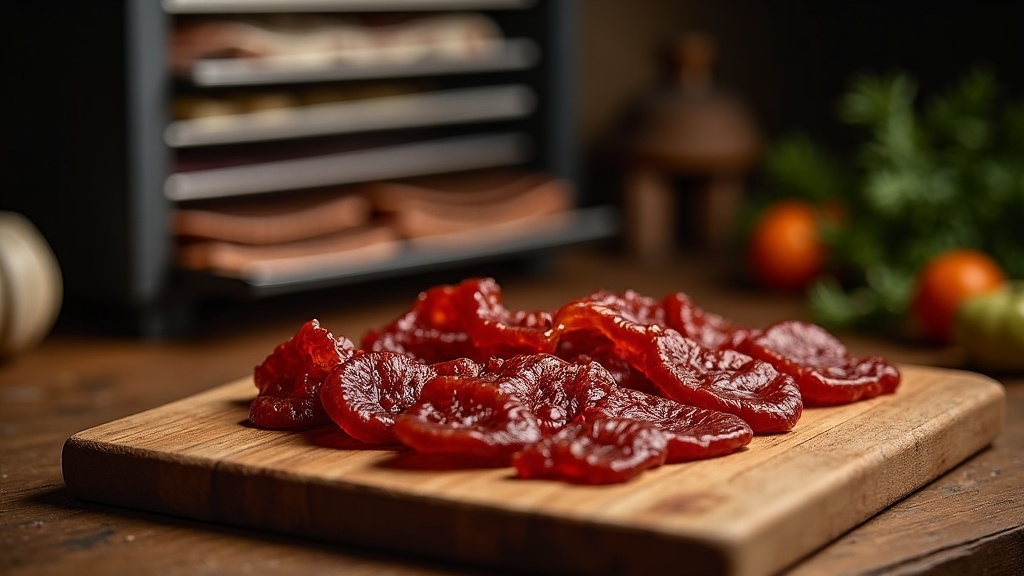
I’ve ruined enough jerky batches in my garage to know where this topic goes sideways fast. If you are wondering how long to dehydrate jerky, the honest answer is usually 4 to 8 hours, with most home batches landing around 5 to 7 hours. That is the useful range, but it is still only a starting point. Jerky finishes by texture, not by timer.
What matters most is slice thickness, how wet the meat is when it goes on the trays, how much sugar is in the marinade, and how hard your dehydrator moves air. Two batches can use the same recipe and still finish an hour apart. That is normal.
The Short Answer
For sliced beef jerky in a dehydrator set to 160F, start checking thin pieces around the 4-hour mark. Most standard 1/8-inch slices are ready in 5 to 7 hours. Thick, heavily marinated, or crowded batches can run 8 hours or longer.
If you want one rule to remember, it is this: pull jerky when it bends and shows small cracks in the fibers, not when the clock hits a certain number. Slightly underdried jerky stores poorly. Slightly overdried jerky is still safe and edible, just tougher.
What Actually Changes Jerky Time
Drying time is mostly about how much water has to leave the meat and how efficiently your dehydrator removes it. These are the variables that move the needle the most:
- Thickness: Uniform 1/8-inch slices are the easiest to dry predictably. Pieces closer to 1/4 inch take much longer.
- Marinade load: Honey, brown sugar, teriyaki, and Worcestershire-heavy marinades keep the surface tacky longer.
- Blotting: Meat that goes onto the trays dripping wet can add a surprising amount of extra time.
- Airflow: Rear-fan dehydrators usually dry faster and more evenly than weaker stack-tray units.
- Batch size: Overloaded trays slow evaporation and create uneven drying from tray to tray.
This is why experienced jerky makers check early and rotate trays when the machine has obvious hot spots. It is also why copying someone else’s exact number of hours rarely works perfectly on your first batch.
A Practical Time Guide
Use this as a field guide for beef jerky at 160F, not as a hard schedule:
- 4 to 5 hours: Very thin strips, light marinade, plenty of tray space, strong airflow.
- 5 to 7 hours: The normal range for most home jerky batches.
- 7 to 8 hours: Thicker slices, wetter surfaces, sweeter marinades, or a slower dehydrator.
- 8+ hours: Extra-thick strips, crowded trays, humid conditions, or mixed-thickness batches.
If you sliced your meat unevenly, do not expect the whole tray to finish together. Pull done pieces as you find them and let the thicker ones keep going.
How to Tell When Jerky Is Done
The bend test is still the best home check. Let a piece cool for a minute, then bend it. Finished jerky should flex, feel dry on the surface, and show small white cracks in the fibers. It should not snap cleanly like a cracker, but it also should not fold like lunch meat.
- Done: Dry outside, firm center, bends with slight cracking.
- Underdone: Soft center, visible moisture, folds easily, feels greasy or cool inside.
- Overdone: Brittle, sharp snap, very hard chew.
Check pieces from different trays, especially if your dehydrator dries unevenly. The back, top, or center often finishes first depending on the machine.
Mistakes That Stretch Drying Time
The biggest timing mistake is loading meat straight from the marinade without patting it dry. You are not helping flavor at that point. You are just asking the dehydrator to boil off extra liquid first.
The second mistake is chasing tenderness by pulling jerky early. Freshly dried pieces can feel softer while still warm. Cool them briefly before judging. A lot of “perfect at 4 hours” jerky turns out to be underdried once it sits.
The third mistake is mixing wildly different slice thicknesses in the same batch. Jerky gets much easier when you standardize your slicing and stop treating the dehydrator like a set-it-and-forget-it oven.
If you are shopping around this topic, I would at least compare jerky dehydrators and vacuum sealers for jerky because both can change how consistent your batches turn out and how long they hold quality.
Bottom Line
Most beef jerky needs 5 to 7 hours in a dehydrator, but you should begin checking at 4 hours and expect the full range to run 4 to 8 hours depending on thickness, marinade, and airflow. The clock gets you close. Texture tells you when you are done.
If you want more consistent batches, focus less on finding a magic number of hours and more on slicing evenly, blotting well, spacing the strips, and learning the bend test. That is the difference between guessing and making repeatable jerky.
One thing I have learned from repeating the same batch with small tweaks is that jerky problems usually stack. A slightly thick slice plus a sugary marinade plus a dehydrator that runs cool can turn a normal batch into something sticky in the middle and over-dry on the edges. That is why I like changing one variable at a time instead of guessing at everything at once.
I also think yield matters more than beginners expect. A cheap cut, weak marinade, or sloppy slicing job can look fine at checkout and still leave you with a disappointing amount of finished jerky. When I compare methods or cuts, I am not only looking at flavor. I am looking at how much good jerky I actually pull off the trays and whether I would want to do that same batch again next weekend.
Price per pound can also trick you if you do not think about trim loss. A roast that looks cheap but has extra fat, awkward seams, or a shape that wastes slices can stop being a bargain fast. I would rather pay a little more for a cleaner roast that gives me straighter strips and less trash on the cutting board.
The other thing I watch is how forgiving the cut is when my slicing is not perfect. Some cuts still make solid jerky even when a few strips come out uneven. Others punish you with a batch that finishes in stages. For a home dehydrator setup, that forgiveness matters a lot more than people expect.
One thing I have learned from repeating the same batch with small tweaks is that jerky problems usually stack. A slightly thick slice plus a sugary marinade plus a dehydrator that runs cool can turn a normal batch into something sticky in the middle and over-dry on the edges. That is why I like changing one variable at a time instead of guessing at everything at once.
I also think yield matters more than beginners expect. A cheap cut, weak marinade, or sloppy slicing job can look fine at checkout and still leave you with a disappointing amount of finished jerky. When I compare methods or cuts, I am not only looking at flavor. I am looking at how much good jerky I actually pull off the trays and whether I would want to do that same batch again next weekend.
Price per pound can also trick you if you do not think about trim loss. A roast that looks cheap but has extra fat, awkward seams, or a shape that wastes slices can stop being a bargain fast. I would rather pay a little more for a cleaner roast that gives me straighter strips and less trash on the cutting board.
The other thing I watch is how forgiving the cut is when my slicing is not perfect. Some cuts still make solid jerky even when a few strips come out uneven. Others punish you with a batch that finishes in stages. For a home dehydrator setup, that forgiveness matters a lot more than people expect.
Why This Technique Works
Jerky dries well when moisture leaves the meat steadily instead of all at once. That means airflow, strip thickness, and marinade sugar level matter just as much as the clock. A batch that is sliced evenly and spaced well can finish predictably, while a batch with mixed thickness can feel random even in the same dehydrator.
That is why I trust process more than one magic time. The clock gives you a range. Texture and consistency tell you whether the batch is actually done.
Step-by-Step Method
- Slice the meat as evenly as you can so the trays finish close together.
- Pat excess marinade off the strips so the outside does not stay tacky too long.
- Arrange the strips with space between them so air can move freely.
- Start checking the thinner pieces first instead of assuming the whole tray is ready at once.
Time, Texture, and Doneness Cues
For most home batches, I expect a useful checking window rather than one exact finish minute. I look for jerky that bends, cracks lightly, and no longer feels wet in the middle. If it snaps hard, I usually went too far. If it stretches like cooked steak, it still needs more time.
I also like pulling one piece, letting it cool for a minute, and testing that sample before calling the tray finished. Warm jerky can fool you into thinking it is softer than it will feel once it rests.
Mistakes That Ruin the Batch
The biggest mistakes are crowding the trays, trusting the timer more than the meat, and slicing with too much thickness variation. Sugary marinades can also darken early and trick you into thinking a batch is done before the center has actually dried enough.

