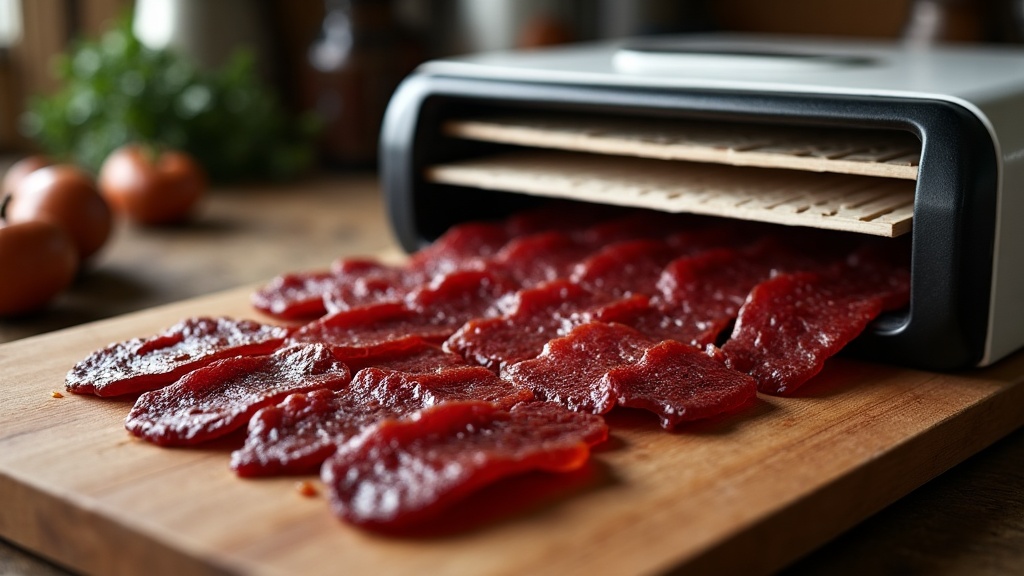
I’ve ruined enough jerky batches in my garage to know where this topic goes sideways fast. If you want the safest temperature to dehydrate jerky, use 160°F for beef, venison, and other red meats, and 165°F for poultry. That matches current USDA home jerky guidance, and it matters because jerky dries slowly. If the meat spends too long in the warm-but-not-hot zone, bacteria can survive long enough to cause trouble.
The part that confuses a lot of people is that drying temperature and safe internal temperature are not always the same thing. Plenty of recipes talk about running a dehydrator at 145°F to 155°F for texture, but the safety target is still getting the meat hot enough first. If your dehydrator cannot reliably get the meat to that mark, the safer move is to preheat or finish the jerky in the oven so you know the batch crossed the line.
The Short Answer
For home jerky, the safest benchmark is simple: heat whole-muscle beef or game to 160°F, and heat chicken or turkey to 165°F. After that, keep drying until the strips are dry, leathery, and bend without snapping cleanly in half.
In practice, that usually means either setting the dehydrator to 160°F if it truly holds that temperature, or using the oven as a safety step before or after drying. I do not trust dial labels alone. I trust an oven thermometer, a batch that dries evenly, and a process I can repeat every time.
What Is Causing the Problem
Most jerky safety mistakes come from mixing up “dry enough” with “hot enough.” Drying preserves the meat, but heat is what knocks down the dangerous bacteria first.
- A lot of dehydrators cycle lower than the number printed on the knob.
- Thick strips and sugary marinades slow down drying and make heating less predictable.
- People often pack trays too tightly, which blocks airflow and creates cool spots.
- Recipes copied from older blogs may focus on texture but skip the USDA safety step.
That is why two batches can look identical and still not be equally safe. One may have crossed the USDA temperature target early and dried cleanly. The other may have spent hours hovering below it, which is exactly what you do not want with meat.
How I Fix It Batch to Batch
My rule is to build the process around the safety target first, then tune texture second. That keeps the batch consistent and cuts down the guesswork.
- Slice the meat evenly, usually around 1/8 to 1/4 inch thick, so every strip heats at about the same rate.
- Preheat the dehydrator and verify the tray temperature with a thermometer instead of trusting the factory dial.
- If I am making beef jerky, I make sure the meat reaches 160°F; for turkey or chicken, 165°F.
- Then I keep drying until the pieces are leathery, dry to the touch, and show white fibers when bent.
If your machine tops out at 145°F or 155°F, use the oven to close the safety gap. That one adjustment is usually the difference between a process that just sounds right and one that is actually defensible.
What to Check First
Before blaming the marinade or the meat, check the process itself. The weak point is usually the machine or airflow, not the recipe.
- Confirm your dehydrator can really run at 160°F, not just claim it on the box.
- Make sure strips are not touching or folded over on the trays.
- Trim excess fat, because fat does not dry well and shortens shelf life.
- Start with cold, refrigerated meat and marinate in the fridge, never on the counter.
If any of those basics are off, the batch gets less predictable fast. Jerky is forgiving on seasoning, but it is not forgiving on temperature control or crowded trays.
When to Toss It and Start Over
If you are not sure the meat ever reached a safe temperature, I would not store it at room temperature and pretend for the best. Refrigerate it immediately and use it quickly, or discard it if the process is unclear enough that you cannot trust the batch.
Toss it outright if it smells off, feels greasy or damp after cooling, shows mold, or sat too long in the danger zone before drying. Jerky is cheap compared with a foodborne illness problem, and a questionable batch is not worth salvaging.
If you are shopping around this topic, I would at least compare jerky dehydrators and vacuum sealers for jerky because both can change how consistent your batches turn out and how long they hold quality.
Bottom Line
The safest temperature to dehydrate jerky is really a safe heating target: 160°F for beef or venison, 165°F for poultry, then dry until the texture is right. That is the standard I would use even if a recipe says lower.
If your dehydrator can truly hold 160°F, great. If not, add an oven step and keep the rest of the process tight. Safe jerky is not about one magic marinade or gadget. It is about hitting the right temperature on purpose, every batch.

